
6 Tips for Navigating Your New Role as a Grandparent
Want to be the world’s best grandparent? Here's expert wisdom from professionals and seasoned grandparents.

In This Article
Becoming a grandparent ranks near the top of the list of life’s most joyful moments. In this crucial role, you have an opportunity to support your child through a whole new chapter. In an ideal world, grandparents make life easier for the new family, and new parents experience a heightened level of appreciation for grandparents as they take on this new role. This ideal state is achievable, though it requires communication, collaboration, understanding and a little bit of grace from everyone involved.
Growing into your new role as a grandparent may take some time, but being aware of some common boundaries for grandparents—and how to talk about them with your adult children—can deepen your bond with the new parents and help establish a lifelong connection with your grandchild.
Tip #1: Follow Your Child’s Emotional Lead
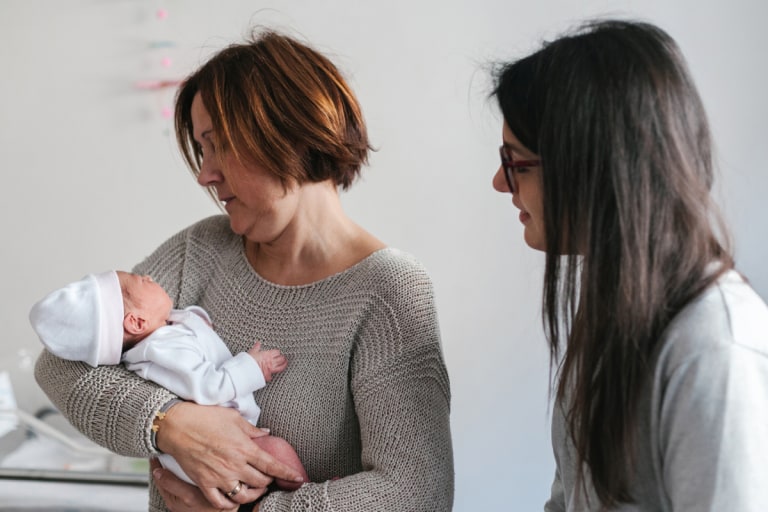
From visiting your newborn grandchild after they’re born to watching your child become a parent themselves, becoming a grandparent certainly has its share of magical moments. It can also be a challenge to navigate your new role. Your desire to snuggle and spoil your grandchild may occasionally be at odds with your sleep-deprived child’s parenting plans, priorities and emotional state.
“New parents will remember—and be grateful—that you followed their lead and respected their wishes,” says Seana Diemer Iwanyk, LMFT, a therapist at The Mother Hood, a maternal mental health practice in Los Angeles. “New parents are trying to establish themselves as a family unit, especially if they are able to take the time to do so. And every family unit is different. Some parents may be dying for visitors and company because they feel isolated while some might want to cocoon.”
And while most new parents are likely going to be a bit anxious and probably teary at some point, postpartum depression and postpartum anxiety can affect both parents, says Iwanyk. That said, she encourages grandparents to be on the lookout for symptoms and offer support if necessary.
Tip #2: Agree on the Length of Your Visits (and Keep the Dates Flexible)
Many grandparents get the opportunity stay with the new family for a period of time to help out when a new baby is born. How long they stay (and how well everyone gets along during this time of adjustment) can vary greatly depending on everyone’s wants and needs. The key is to remain flexible.
For example, if you’re flying to see the new baby, be sure to book a ticket that allows for no-fee changes or cancellations. And once you’re in the midst of a visit, it can help to be open to whatever that might look like. You might come by on a day that the baby ends up sleeping for the duration of your visit, notes Iwanyk.
“Whatever the visit looks like, follow the new parents’ lead,” she says. “Whether you’re visiting from across the ocean or from two doors down, [you’re there to] support the parents and help with the baby.”
Tip #3: Update Your Baby Knowledge
From feeding options to sleep positions, baby products to car seats, basic recommendations around how to provide the best and safest care for a newborn are always evolving. Take the initiative to brush up on the latest parenting and baby guidance. Not only will this feel empowering but it will make it easier to get in sync with your child.
“Doing research proactively and discussing it with the parents goes a long way in showing that you understand that things have changed over time,” points out Iwanyk. “Of course, you're going to want to make sure that you're researching things in line with the parents' rules and boundaries, and it doesn't hurt to ask if they have certain thoughts on various practices. But no parent is ever going to be upset that you took the initiative to take an infant first aid course.”
You’re also taking a task off of your child’s plate, notes Iwanyk. “Doing some of this research ahead of time also takes the emotional labor off the parent to be watching the grandparent to see if they need correction,” she says.
Consider researching the latest, expert-backed advice on:
For general pediatrician-led advice, check out HealthyChildren.org from the American Academy of Pediatrics.
It’s possible that you’ll remember doing any number of these things in a very different way, which could set the stage for conflict with your child. Take heart that being corrected isn’t necessarily a criticism.
“Often comments about outdated parenting norms, especially changes in safety protocols, come off as defensive when a parent corrects a grandparent,” acknowledges Iwanyk. “It's OK that things were done differently. It doesn't mean that anyone was a ‘bad’ parent; it just means that we have more information now.”
Tip #4: Know Your Grandparent Boundaries and Stick to Them
Most parents agree that one of the most helpful things grandparents can do is ask a lot of questions, whether around when they can visit or if they can buy their grandchild a particular gift. That said, you might try rephrasing statements as questions. For instance, instead of “I want to visit this weekend,” try “Would you like a break this weekend? I can come watch the baby.”
This can go a long way to show that you’re considering the implications of how you’re showing up for your child and their family.
At the same time, keep in mind that your child may have to balance your role in the grandkids’ lives with their partner’s parents. Having two (or more!) sets of grandparents can sometimes generate competition for grandkids’ attention and affection, but remember: There’s more than enough love to go around.
Tip #5: Discuss Caretaking and Consider Outfitting Your Home and Car
You might be excited about the idea of actively pitching in with care duties or even taking overnights. While either or both of those responsibilities may be in the cards, talk to your child ahead of time to clarify how you’ll be pitching in, advises Iwanyk.
“It’s important to ask questions about childcare, if the parents would like you to have a role, what their needs are and what you can realistically provide,” she notes.
Assuming all of that is a go, you’ll then want to ask the new parents how they feel about your home and car seat setups as well as how involved in the process they’d like to be, says Iwanyk. For instance, you might ask if they have specific wishes or feelings around various pieces of baby gear, whether that’s a certain type of bassinet or playard. (And if you need help on current recs, we have recommendations for grandparent-friendly car seats and baby gear that’s great to have on hand at grandparent's house.)
“Asking how they feel will make them more confident that you’re in this with them and to be supportive,” says Iwanyk.
Tip #6: Always Defer to the Parent(s)
Your child might ask you to visit only at certain times during the week or to rewash your hands before touching your grandchild. Some grandparents struggle with accepting the rules their children set for them. But, according to Dr. Marshall P. Duke, member of the National Advisory Council for the Jewish Grandparents Network, professor of psychology at Emory University and proud grandfather of nine, grandparents will do best to “accept a secondary role in raising grandkids…and defer to the parents.”
So, whether your kids want to stick to a strict nap schedule, feed the baby in a particular way, or forbid pacifiers, those choices belong to them. “Respecting their boundaries and rules, even if you don’t totally understand or agree with them, is an important step to helping parents feel supported and empowered as they build their new family together,” says Iwanyk.
Ultimately, as excited as you are about your grandchild, you’ll benefit the most from showing up for the parents in whatever ways they see fit. As Iwanyk puts it, “That is where that bond is truly going to grow.”
