
The Best Rotating Car Seats of 2026
These innovative car seats spin to make getting your little one in and out of the car a whole lot easier.

By
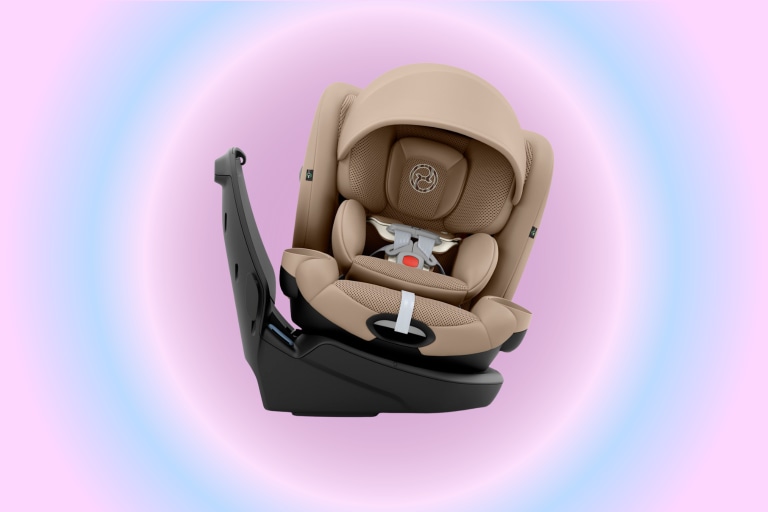
As baby gear innovations go, the rotating car seat is a big one. These seats swivel at the base, which sounds like a flashy extra but is actually incredibly practical. Being able to turn the seat toward you makes getting a baby (or an opinionated 35-pound toddler) in and out of the car so much easier.
As a Child Passenger Safety Technician (a CPST, someone specially trained in car seat use and education), I’ve worked with a lot of rotating seats and watched their popularity explode over the past few years. I’ve tested them extensively as Babylist’s Senior Gear Editor and used several different models with my own kids. And I’m happy to report: rotating seats aren’t a gimmick. After using one with my own son for the last few years, I truly can’t imagine ever going back to a traditional convertible.
For this guide, I narrowed things down to five rotating car seats that truly stand out. These are seats I’ve personally tested, installed and used, and that consistently get high marks from other Babylist parents. After weighing ease of install, everyday usability, safety features and long-term fit, the Cybex Callisto G 360° Rotating All-in-One Convertible Car Seat rose to the top as the best rotating seat for most families.
I’ve also included several other standout options depending on your priorities, whether it’s something slimmer for tight back seats, a more affordable pick, a seat you can rear-face longer and more.

How We Judged
Best Rotating Convertible Car Seat Overall
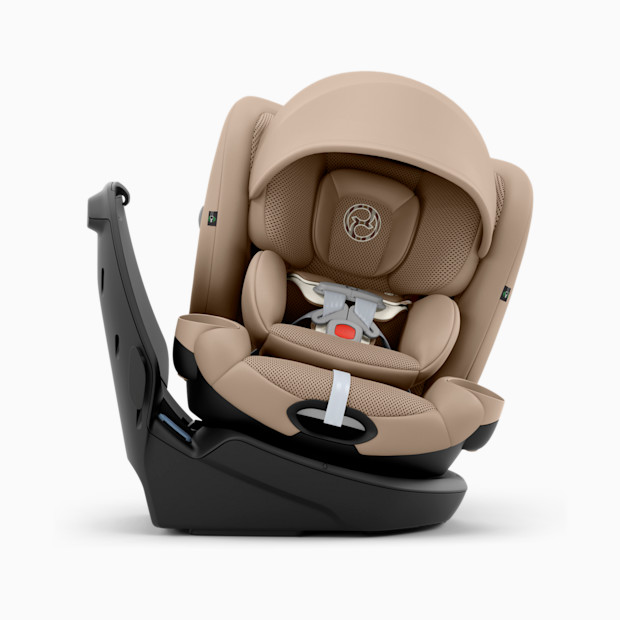
Cybex Callisto G 360 Rotating All-in-One Convertible Car Seat - Almond Beige
From $699.95Pros
- Smooth 360° rotation in all modes
- 3 modes of use; good child fit in all modes
- Premium safety features, including anti-rebound base and rear-facing tether
- Extremely plush and comfortable
- Canopy
Cons
- Expensive
- Bulky, long front-to-back
TL;DR
If you want a rotating seat that’s easy to install, rotates effortlessly and offers strong safety features and comfort, the Callisto is the best I’ve tested. It’s an investment, and a larger seat, but it genuinely delivers.
There are certain features I look for in a rotating car seat: a one-and-done install, a rotation button that's easy to access one-handed, a smooth 360-degree rotation, strong safety features and an easy installation. The Callisto offers all of the above, and so much more. It's an investment, but it's the best rotating car seat I've tried (and I've tried many), and it's the seat I've used with my own son for almost two years. And Babylist parents agree. "I knew it would be pretty cool, but I didn't think it would be as great as it is!" shared one parent in our annual Most Loved Baby Products survey. "It truly is a lifesaver in so many scenarios, and I can't imagine my life without it."
First, the rotation itself. It’s smooth, intuitive and easy to activate, even one-handed. The button is large and well placed, and the seat turns effortlessly in all modes. For daily life, especially with bigger toddlers who don’t love being buckled, this makes a noticeable difference.
Fit is equally strong. The Callisto has three modes of use (rear-facing, forward-facing and high-back booster) and provides a good child fit in each. It also has a high top harness height, making it a great option for taller kids.
On the safety front, the Callisto stands out with an anti-rebound base for crash energy absorption, side-impact protection and a tether strap that works in both rear- and forward-facing modes. (Tether straps help limit a car seat’s forward movement in a crash, protecting your child’s head. All forward-facing convertible seats use them, but not all rear-facing seats do.)
Comfort and convenience are equally impressive. Installation is quick and there's a generous range of recline and headrest positions. The fabric is so plush but also breathable, as well as GREENGUARD Gold Certified and flame retardant-free. There’s a smart chest clip that sends alerts if your child unbuckles or if the seat gets too hot or cold. And there’s even a canopy, something rarely found on a convertible car seat—definitely my toddler’s favorite feature. (Just note that you can’t use the canopy in booster mode.)
Worth noting
-
It’s large and takes up significant front-to-back space, especially rear-facing. It’s not ideal for small cars or tight three-across setups.
-
It's the most expensive rotating seat currently on the market, but you’re paying for premium features and functionality.
-
Not all car seats and boosters work in vehicles with non-removable headrests, but this one does in most cases. (I drive a Jeep Grand Cherokee L, a vehicle notorious for its protruding, non-removable headrests, and have no issues with this seat.)
Additional Specs
-
Seat Modes: Infant, convertible, high-back booster
-
Child Guidelines: Rear-facing: 4-40 lbs, up to 43.3”; forward-facing with harness: 26.5-65 lbs, 33-49.2”; high-back booster: 40-120 lbs, 44-57”, min 4 yrs
Honorable Mention
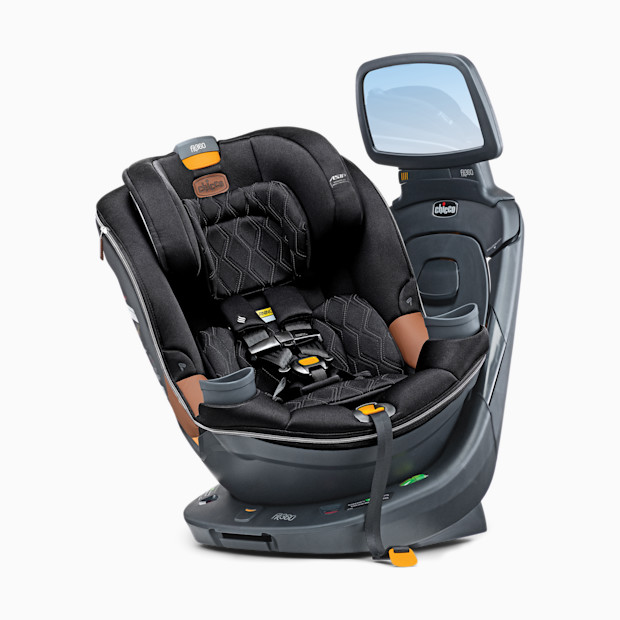
Chicco Fit360 Zip ClearTex Rotating Convertible Car Seat - Jet
From $489.99Pros
- Smooth 360° rotation in all modes
- Straightforward installation
- Can purchase additional bases
- Zip-off cover + crash-tested mirror
Cons
- Bulky, especially front-to-back when rear-facing
- Seat is slightly deep, making loading/unloading more difficult
TL;DR
An easy-to-install, user-friendly rotating seat with thoughtful features and a more approachable price than the Callisto. It’s still on the larger side, but for many families, the Fit360 hits a great balance of performance and value.
Chicco's Fit360 is another excellent rotating car seat pick, grabbing our Honorable Mention spot. It's a bit more affordable than the Callisto and earns praise from both parents and CPSTs (myself included) for its smart design, safety-forward engineering and everyday ease of use.
The first thing we noticed when testing this seat was the ease of installation with the LeverLock system. “The instructions were clearer than others,” our tester, Laura, noted. “We’ve installed a Graco Contender 65 Convertible Car Seat, Nuna Rava and a few other rental car seats on vacation, and this one was by far the most intuitive, with logical steps and identification.”
The buttons to turn the seat are easy to access and the rotation is smooth. Like most parents who use a rotating car seat for the first time, our tester was both impressed and surprised. “The rotating feature is a game changer for child entry and exit,” she said. “Not only is it easier on the caregiver, my two-year-old daughter also has fun getting in and out of the car seat now, which is something we’ve been struggling with lately.”
Where this model stands out is in its practical details. The Zip ClearTex version features a machine-washable zip-off cover, a huge plus for messy toddlers, along with GREENGUARD Gold Certified fabrics and no added flame retardants. The magnetic chest clip and flex-forward crotch buckle make daily buckling easier (no digging around for that buckle under your baby's bottom!), and the included mirror attaches directly to the base at the correct angle, which eliminates the usual mirror-adjustment struggle. (It has also been crash tested specifically with this seat. Just note you can't use it when the seat is rotated forward-facing.)
It's also one of only a few rotating seats on the market to offer additional bases, so you can switch the seat between cars instead of buying a completely new seat for every vehicle. There’s also a built-in release safeguard, so the seat only detaches from the base when you want it to. (Just know the seat itself is pretty heavy, however. And the seat must always be used with its base, never on its own.)
Worth noting
-
Like many rotating seats, it’s bulky and takes up significant front-to-back space, especially rear-facing.
-
The seat depth makes loading slightly more awkward than with shallower seats.
-
Some parents report that the magnetic chest clip is easy for some toddlers to open.
-
For added safety, consider purchasing the LeverLock Door Cover to prevent tiny feet from tampering with the base’s release lever.
Additional Specs
-
Child Guidelines: Rear-facing: 4-40 lbs, up to 43”; forward-facing: 26.5-65 lbs, up to 49”
-
Weight: 33.8 lbs
The rotating feature on the Fit360. (Video: Laura Johnson, Babylist Senior Marketing Manager)
Best for Extended Rear-Facing
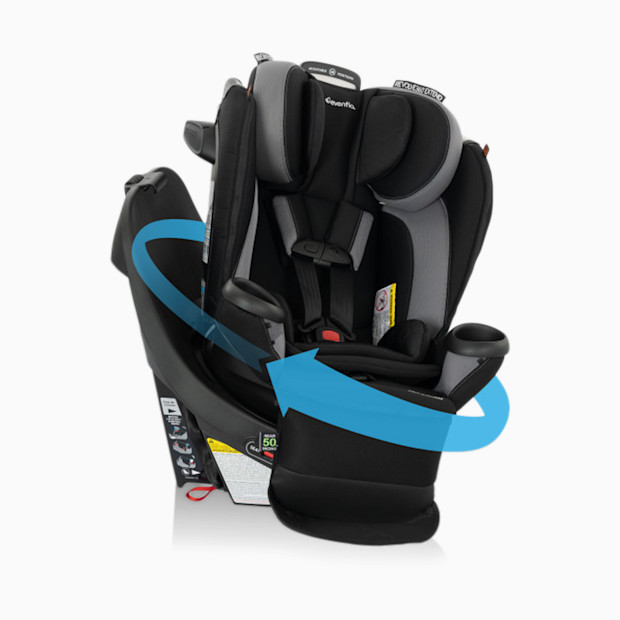
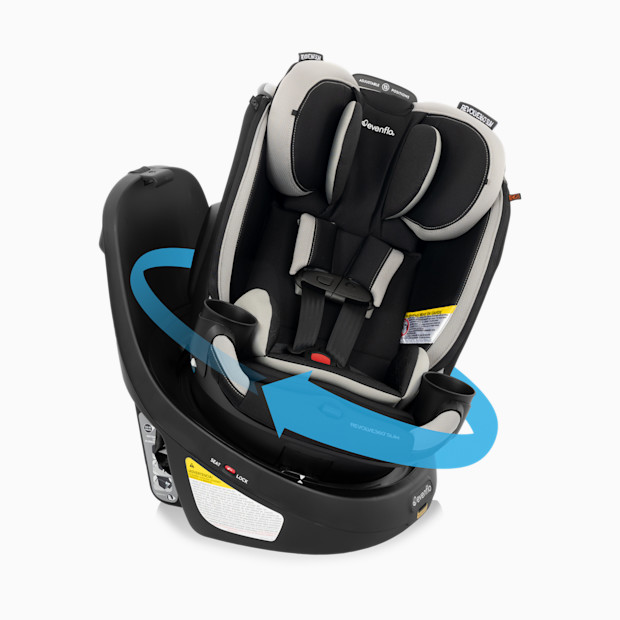
Evenflo Revolve360 Extend All-in-One Rotational Car Seat with Quick Clean Cover - Revere Gray
From $349.99Pros
- High rear-facing height and weight limits
- Smooth 360° rotation in all modes
- Anti-rebound panel
- Easy-to-remove machine washable cover
Cons
- Long seat front-to-back
- Newborns and smaller babies may not fit well
- Straps twist easily
TL;DR
If keeping your child rear-facing as long as possible is your top priority, the Revolve360 Extend is one of the strongest rotating options available. It combines high rear-facing limits with a smooth swivel that makes sticking with rear-facing more manageable day to day.
Rear-facing is the safest way for young children to ride, and car seat experts, including the American Academy of Pediatrics (AAP) and the National Highway Transportation Safety Administration (NHTSA), recommend keeping kids rear-facing as long as their seat allows. The Revolve360 Extend makes that easier to commit to, thanks to rear-facing limits up to 50 pounds and 48 inches—higher than many rotating seats on the market.
Evenflo has been a leader in the rotating car seat category for several years, and the Extend model is my favorite of the lineup specifically because of those extended rear-facing capabilities. The rotation is smooth, the buttons are easy to access (there’s one on each side), and switching between rear- and forward-facing modes is doesn't require you to uninstall and reinstall the seat. (You will have to reinstall it when you switch to booster mode, however.)
Babylist parents appreciate the seat's practicality. “It's so easy to install and use,” wrote one parent in our annual survey. “As baby has gotten bigger, I don’t feel like I’m wrenching my back and arms to put him in the rear-facing position and then strap him in. I can easily place him in the seat, strap him in, and then rotate him to the rear-facing position.”
The seat is designed as an all-in-one, transitioning from rear-facing to forward-facing and eventually to a high-back booster. It also includes an anti-rebound panel for additional crash force management and a machine-washable cover, two practical features that matter over years of use.
Worth noting
-
The seat takes up a fair amount of front-to-back space, especially when rear-facing, which may be challenging in smaller vehicles.
-
It’s also wider than some rotating seats; if you need a slimmer option, the Revolve360 Slim, which we review below, may be a better fit.
-
Newborn fit isn’t ideal, so many families may prefer starting with an infant seat.
-
The harness straps can twist more easily than some competitors.
Additional Specs
-
Child Guidelines: Rear-facing: 4-50 lbs, up to 48”; forward-facing: 30-120 lbs, up to 57”
-
Weight: 29.6 lbs
The rotation feature on the Evenflo Revovle360 Extend is smooth and easy. (Photo: Tonya Baker, Babylist Director, Brand and Visual Design)
Best Value
Joie Chili Spin SI 2-in-1 Convertible Car Seat - Dove
From $339.99Pros
- Good value
- Spins 360° for easy in and out
- Straightforward installation
Cons
- Must reinstall when switching from rear- to forward-facing
- Bulky harness pads
TL;DR
A thoughtfully designed rotating seat that delivers many premium features at a lower price point. It’s not perfect, but for families who want rotation without the highest-end price tag, the Chili Spin SI offers excellent overall value.
Many rotating car seats land well north of $400. The Chili Spin SI comes in lower than most—but doesn’t feel like a stripped-down version of something better.
This rotating car seat has a lot going for it, but even more so when you consider the price point. It's notably easy to install. I’ve taken it in and out of my car at least ten times now, and it consistently takes under a minute. The lock-off panel makes getting a tight fit straightforward, and the rotation buttons are large and easy to access. It’s also fairly compact front-to-back, with good recline options that help it fit comfortably in most vehicles.
From a safety standpoint, it includes features I like to see at any price point, including an anti-rebound panel. And it rotates smoothly in both rear- and forward-facing modes.
Worth noting
-
You’ll need to uninstall and reinstall the seat when switching from rear- to forward-facing mode, since the tether is only used forward-facing. Installation is quick, but it’s something to plan for.
-
The shoulder harness pads are stiff and oversized. The good news: they’re optional and can be removed.
Additional Specs
-
Child Guidelines: Rear-facing: 4–40 lbs, up to 43”; forward-facing: 30-65 lbs, up to 49”
-
Product Weight: 28.57 lbs
Best Slim Fit Rotating Car Seat
Evenflo Revolve360 Slim 2-in-1 Rotational Car Seat with Quick Clean Cover - Salem Black
From $399.99Pros
- Fits 3-across in most cars
- Rotates 360 degrees
- High rear-facing weight limit (50 lbs)
- Easy-to-remove machine washable cover
Cons
- May not be comfortable for larger/wider kids
TL;DR
If you want the benefits of a rotating car seat but have limited back seat space, the Revolve360 Slim is your best bet. It keeps the smooth swivel and extended rear-facing of the original in a noticeably narrower footprint.
The swivel function is what makes rotating car seats stand out, but it’s also the reason they take up more room in a back seat than many traditional convertible car seats. (Rotating seats are wide, plus you have to ensure enough clearance in the middle to allow the seat to turn.) The Evenflo Revolve360 Slim is your best shot at making a rotating car seat work if you own a smaller vehicle, need to fit multiple car seats across or just want a little more room in your back seat.
The Revolve360 was designed with space-saving in mind, shaving about three inches off its width compared to the Extend. This slimmed-down seat measures 16.7 inches across and creates a smaller footprint without sacrificing seating space or safety. I’ve used both seats (the Slim is currently installed in our caregiver’s car), and I’m consistently impressed at just how compact it is.
While you couldn’t use three Slims across the back seat of an average-sized vehicle (they might fit space-wise, but you’d lose the swivel function and defeat the purpose of a rotating seat), it's still a helpful back seat space-saver. And there's a small chance you could fit a non-rotating car seat in the middle seat and a slim on either side if you need a three-across configuration. (Just note this is pretty rare; in most instances, you'll lose the rotation functionality if there's a car seat next to a rotating seat.)
Like the OG Revolve, the Slim 2-in-1 rotates 360 degrees in all modes and works as both a rear- and forward-facing seat. You’ll only need to install it once, and installation is just as quick and easy as it is with all of the other rotating seats in Evenflo’s lineup. There are also the same thoughtful features like the machine washable cover, several recline options and extended rear-facing capabilities.
Worth noting
-
The Slim works only as a rear- or forward-facing convertible, while the Extend ultimately transitions to a high-back/belt-positioning booster as your child grows.
-
Some larger kids may feel uncomfortable more quickly than they would in a non-slim seat.
Additional Specs
-
Child Guidelines: Rear-facing: 4-50 lbs, 17-48”; forward-facing: 22-65 lbs, 28-49”
-
Weight: 28.2 lbs
The Evenflo Revolve360 Slim is a narrow seat, as pictured here next to a Graco convertible car seat. (Photo: Babylist)
Why Trust Babylist?
Babylist is the expert in baby; we know baby gear inside and out. We talk with parents face-to-face in our showroom and on our user panels and hear from thousands annually via our Best Baby Products online survey. We know what items millions of expecting parents are adding to their baby registries.
-
Firsthand professional and personal experience. As a CPST, I'm trained in car seat installation, usage and safety, staying up to date on car seat education through continuing education classes, seminars and CPST education groups. I'm also Babylist's gear editor; I've been writing about baby gear at Babylist since 2019 and have been the gear editor since 2021. I've tested and reviewed almost every rotating car seat on the market. And I'm a mom of two boys, a preschooler and a middle schooler—so I have over a decade of hands-on car seat experience with my two sons and have used several rotating seats with my younger child.
-
Expert POV. While researching this guide, I spoke to Joe Colella, Director of Child Passenger Safety at the Juvenile Products Manufacturers Association, a leading industry voice on quality and safety for baby and children’s products and 2020 Child Passenger Safety Hall of Fame Inductee, and Dr. Alisa Baer, a pediatrician and the co-founder of The Car Seat Lady. I spoke with three fellow CPSTs: Samantha Taylor, founder of Mama Knows Car Seats, Rebekah Kimminau, founder of The Baby Gear Consultant and Lani Harrison. I also reviewed the latest safety data and recommendations from professional organizations like the American Academy of Pediatrics (AAP) and the National Highway Traffic Safety Administration (NHTSA) and leading voices in child car seat safety such as Safe Kids Worldwide and Car Seats for the Littles.
-
Rotating car seat data. I regularly analyze which baby products our users are adding to their baby registries the most (and which ones they aren’t) and what our team of Merchandising experts—our buyers who are responsible for ensuring the Babylist Shop is stocked with the best and newest gear—is excited about. Studying this kind of data helped us choose which rotating car seats to narrow in on and which ones to recommend to new and expecting parents.
-
Feedback and reviews. I reviewed comments and feedback from Babylist’s annual product survey of thousands of parents, read customer reviews from hundreds of Babylist users and spoke to parents on our staff about their real-life product experiences.
What Is a Rotating Car Seat?
Rotating car seats, also called swivel car seats, are car seats that spin on the base. Infant car seats rotate 180 degrees, while convertible rotating seats rotate either 180 or a full 360 degrees.
A rotating car seat has many of the same features you’d find in a traditional convertible seat, such as a five-point harness, variable recline positions, a LATCH system and, for convertibles, the ability to rear- or forward-face, with the addition of a swiveling seat.
When to buy a rotating car seat
If you're considering a rotating infant car seat, you'll be able to use a rotating option from birth, assuming your baby meets the height and weight minimums.
If you're considering a convertible option, you can also use one from day one. However, convertible seats aren’t as portable or as light as infant car seats, and they can’t be used with a stroller. Most also don't fit newborns and smaller babies well. Most parents choose to start with an infant car seat and switch to a convertible car seat once their little one has reached the infant car seat’s height or weight maximum, usually around one year of age.
Rotating Car Seat Pros and Cons
If you’ve ever tried to wrangle a screaming, squirming child into a rear-facing car seat, you’ll understand pretty quickly why a rotating car seat is such a genius idea. But like most products, there are also some downsides to these types of seats. Here’s how to think through if a rotating seat is right for you.
✅ Pros
-
Ease and convenience. There’s no doubt: it’s easier to get your child into and out of the car with a rotating car seat than if you’re using a traditional convertible. A rotating seat can be especially helpful if you have a physical limitation or if a grandparent or older caregiver will be driving your child, and even for some children with disabilities. “Parents and caregivers with certain physical disabilities might be able to take a child independently in a car using one of these seats but would be unable to do so with a non-rotating car seat,” says Dr. Baer.
-
Safety. “According to the AAP and the NHTSA, it's safest for infants and toddlers to ride rear-facing in a car seat for as long as possible,” says Colella. Rotating car seats make it easier to rear-face your child, and when something is easier, you’re more likely to do it. A growing body of research supports rear-facing as the safest way for babies and young children to ride.
-
Access. A rotating car seat can also be a good option for parents with multiple kids in car seats who need access to their vehicle’s third row. “In vehicles with captain’s chairs in the second row, rear-facing convertible seats typically block access to the center aisle and thus block third-row access, which often prompts parents to turn kids forward-facing too soon in order to preserve that access,” explains Dr. Baer. “A rotating seat may allow for access to the center aisle and thereby encourage a parent to keep the child in the second row rear-facing longer.”
-
Potential one-and-done install. If you’re using a traditional convertible car seat, you’ll need to install it once in rear-facing mode and again when it’s time to forward-face. With most of the rotating car seats on our list (and many others on the market), install it once and you’re good to go. (One caveat is if you’re using your vehicle’s LATCH system to install your seat. In that case, you may need to reinstall the seat using your vehicle’s seat belt once your child hits a certain weight. Be sure to read your seat’s instruction manual carefully to learn the specifics of your car seat.)
❌ Cons
-
Size. The swivel feature—what makes rotating car seats great—is also why they take up more room in your back seat. You may not be able to place a rotating car seat directly next to another car seat (or another passenger) in some vehicles or achieve a three-across configuration if you have three car seat-aged children. And some rotating car seats are very large from front to back, so they are not ideal for sedans or smaller vehicles.
-
Price. Rotating car seats are more expensive than many convertible car seats.
-
Low rear-facing weight limit. Although rotating car seats make rear-facing easier, many have a lower rear-facing weight limit than traditional convertible car seats. That means your child will max out of their swiveling car seat’s rear-facing limits sooner than they would with many other seats (though not sooner than in an infant seat—even the best infant car seats have a lower rear-facing weight limit than rotating car seats).
To see all the differences (and similarities) between rotating, convertible and even all-in-one car seats—plus our recommended picks in each category—check out our Ultimate Car Seat Guide.
Rotating Car Seats and Safety
All families have different needs. The foundational rules for choosing any car seat are the same: it should fit your child, fit your vehicle and be something you can use consistently and correctly, says Colella.
And while rotating car seats may feel new in the US, they’re not new globally. “While the current selection has boomed over the last few years, they’ve actually been around for decades, especially in Europe,” explains Taylor, largely because of differences in European car seat safety regulations.
But are rotating car seats safe?
Yes. All car seats sold in the US must meet the same federal safety standards, and rotating models are no exception. They’re held to the same crash-testing requirements as traditional convertible seats. When evaluating a rotating car seat, Dr. Baer recommends keeping the following points in mind:
-
Pay attention to the seat’s design. Some rotating car seats are made from two separate pieces, a base and a shell. There is potential for these pieces to separate in the event of a crash, and although this is not supposed to happen, the possibility is always there.
-
Construction matters. Like traditional infant seats, rotating car seats connect the shell to the base using different mechanisms. Some, like metal-to-metal connections, for example, are more secure than others, such as plastic-to-plastic.
-
Consider human error. Look for a rotating car seat that minimizes the chances of human error as much as possible. Things like an easy-to-read indicator that shows when the seat is locked into position or a feature that helps you know the seat is properly connected to the base can help maximize your chances of using the seat correctly.
“Rotating car seats are absolutely safe when used correctly,” echoes Taylor. “Like all car seats, it’s important to follow the manufacturer’s instructions.” Her biggest takeaway is to always be sure the seat is in a locked position when the vehicle is in motion. “That rule stands whether the car seat is occupied or unoccupied,” she says. She recommends habitually turning the car seat to a locked position whenever you remove baby from the seat.
You should also always follow these other safety tips:
-
Two-piece rotating car seats (base + shell) must always be used together, never on their own.
-
Never ride with a child facing sideways in a rotating car seat. Always be sure the seat is locked into either a rear- or forward-facing position, whether the child is in the seat or it's unoccupied.
-
Max out your seat’s rear-facing height or weight limits before turning your child forward-facing.