
Doona vs. Evenflo Shyft DualRide: I Tested the Top 2 Combo Systems
Two all-in-one travel systems, one decision. Here’s all the info you need to compare and decide.

By
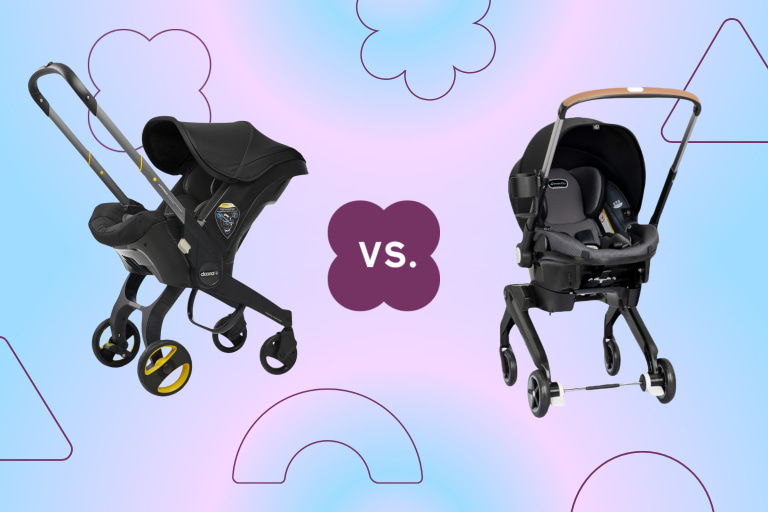
As a new or expecting parent, you’re probably learning a lot about baby gear, including some types of products you might never have seen before. Any research on infant car seats and travel systems is likely to bring you to the concept of a combination system: an infant car seat with a stroller frame built in.
Unlike traditional travel systems, these car seat-stroller combination systems aren’t two separate pieces of equipment where the car seat clicks into the stroller. They’re all one cohesive unit; the stroller wheels fold up underneath the car seat so you can instantly go from car seat mode to stroller mode with no extra gear or adapters necessary.
For eight years, there was only one brand in the combo system category. But now that there are two major options on the market—one from Doona, the original innovative brand, and one from Evenflo, a century-old well known baby brand—how do you choose between them? With six years as a Babylist editor and product tester under my belt, I tried out both the Doona and the Evenflo head-to-head to give you all the details on how they’re similar, how they’re different and which one might work best for you.
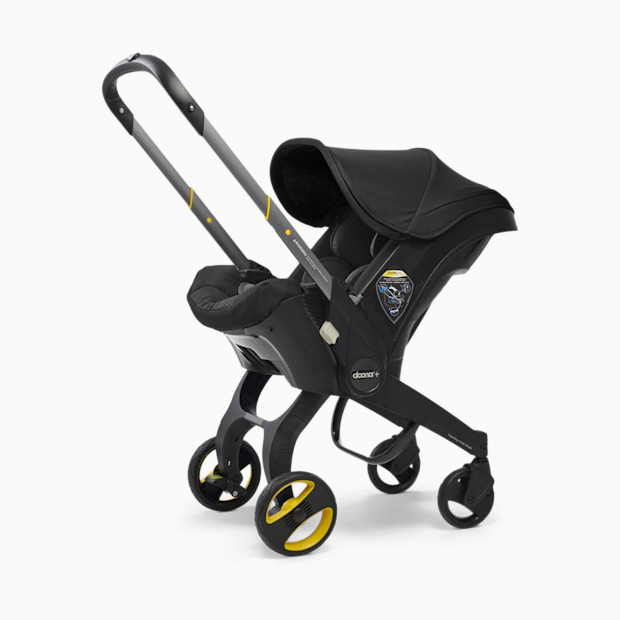
Doona Doona + Infant Car Seat & Stroller - Nitro Black
From $550.00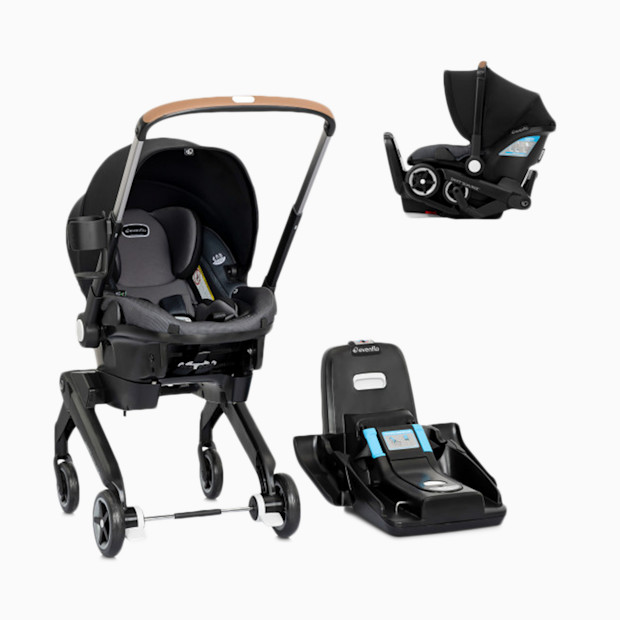
Evenflo Shyft DualRide Infant Car Seat Stroller Combo with Carryall Storage - Boone
From $599.99Doona vs. Evenflo Shyft DualRide: Overview
The original car seat-stroller combo, the Doona, debuted in 2015, and has been growing steadily in popularity thanks to its ultra-convenient, busy-parent-friendly design. For parents looking for the most seamless car seat-to-stroller transition, the Doona was the only all-in-one system on the market—until the Evenflo Shyft DualRide launched in 2023.
As the newcomer in this baby gear category, the Shyft DualRide has a few extra features that make it a solid competitor against the Doona.
At first glance, these two systems look nearly identical. Both combine two pieces of gear into one, fold and unfold with the push of a button and will last through baby’s first year (you may get a few extra months with the Doona if your baby is on the smaller side). Price-wise, the standard models cost almost the same at $550 for the Shyft DualRide versus $600 for the Doona.
But look a little closer and you’ll spot some key differences: the Shyft DualRide’s standard model includes built-in safety tech and convenience features that the Doona lacks, while the Doona has smoother functionality and better fit capabilities for babies.
Doona vs. Evenflo Shyft DualRide: Design & Functionality
Design & Functionality: What’s similar
Both the Doona and the Shyft DualRide have the same basic functionality: wheels are connected to the car seat, allowing parents to switch between carrying or driving and strolling without disturbing baby. (You can see how they fold and unfold below.)
They both also feature a UPF 50+ canopy to keep baby protected from the sun, and both systems have anti-rebound functionality for extra safety (just note that the Doona’s anti-rebound feature only works if the handle is positioned toward baby’s feet/the trunk, which allows it to act as an anti-rebound bar).
When it comes to cleaning, both systems have machine washable seat pads and require all straps, buckles and other pieces be wiped clean using only a soft cloth, water and mild soap.
Design & Functionality: What’s different
While these two systems may look exactly the same at first glance, there are a few design features that differentiate them and may have you considering one over the other.
The biggest difference: The Shyft DualRide’s infant carrier can detach from the stroller frame, offering more flexibility for parents who don’t always want to lug the whole system. It’s a convenient function for moments like carrying your baby into a doctor’s appointment or a quick errand when you don’t have a structured carrier on hand. Additionally, being able to detach the infant carrier drops the product’s overall weight by 11 pounds, which can feel significant. This functionality isn’t possible with the Doona, which requires that you always have the stroller frame and wheels attached.
The Shyft DualRide's infant carrier separates from the stroller frame, but only when the whole system is locked into the base first. The stroller frame remains in the base as the carrier lifts out.
The Shyft DualRide has two different buttons for folding and unfolding, which I found to have a bit of a learning curve compared to the Doona, which has only one button. On the Shyft DualRide, the upper button releases the wheels into stroller mode and separates the carrier when the whole system is secured to the base, while the lower button folds the wheels underneath and releases the stroller frame from the base. I’ll freely admit to getting the two buttons confused even after using it a couple weeks, which was annoying.
Another difference is the direction that the products fold. The Doona’s wheels fold under at baby’s feet, which you can do by placing your foot in front of the rear wheels and pulling gently toward you. On the other hand, the Shyft DualRide folds on the opposite end at baby’s head, so you’ll need to tilt the stroller head-down a bit to fold it. I personally found the Doona’s fold to be smoother and more intuitive (no need to lift it off the ground), while the Shyft DualRide felt a little unwieldy, since I had to pick it up and rock it backward to get the wheels to collapse.
How to fold the Doona: With the brakes engaged, push the handlebar in using the button on top, squeeze the two size triggers to bring the handlebar to the center position, place your foot in front of the rear wheels, squeeze the button on the back of the carrier and gentle push in the direction of baby's feet/toward your foot holding the wheels.
Other minor differences: The Shyft DualRide’s canopy is about two inches longer than the Doona’s, and Evenflo has an option for an extended canopy version as well. And while the cleaning and care instructions are very similar between these two products, the big difference is that the Evenflo’s seat pads are safe to go in the dryer, whereas the Doona’s seat pads need to be hung up to air dry.
Doona vs. Evenflo Shyft DualRide: Weight
Weight: What’s similar
One of the first things you might notice when you actually handle one of these all-in-one travel systems is that they’re pretty heavy. Since they’re more than just regular infant car seats, all that extra functionality means extra weight. At 17 and 19 pounds, both of these products are well above the average weight of a standalone infant car seat.
While typical infant car seats weigh around seven to 12 pounds, these two pack in additional stroller frames and wheels, so that’s something to consider if you’re debating between a traditional infant car seat and an all-in-one combo system. If you’re looking into combo systems as a way to reduce the amount of gear you’re lifting (as opposed to a traditional travel system), these may not be a great fit for you, since you’ll end up needing to lift twice the weight into the car.
Weight: What’s different
The Doona is slightly lighter at 17 pounds versus the Shyft DualRide at 19 pounds, but remember how the Shyft DualRide’s car seat can separate from the stroller frame? The weight of the infant car seat alone is only eight pounds. This difference can be significant when lifting in and out of a car or carrying for extended periods—but only if you leave the stroller frame off.
Doona vs. Evenflo Shyft DualRide: Size & Fit
Size & Fit: What’s similar
If you’re looking to start using an all-in-one car seat-stroller system from the day your baby is born, you might be able to use either of these options for your newborn—but it depends on how big (or small) your baby is.
The main thing to note here is that these systems aren’t great for preemies. The manuals say they can fit babies as small as three pounds (the Shyft DualRide) or four pounds (the Doona), but in reality, babies fit better in these seats when they’re a little bigger than that. For the Doona, babies tend to fit better when they’re above five pounds, otherwise the straps don’t go low enough for a secure fit. For the Shyft DualRide, it’s best to wait until your baby is big enough to wear the straps at the second-lowest level or higher; at their lowest level, the straps position baby’s head at an awkward angle against the headrest, which pushes their chin down in an unsafe way.
Both brands also say their gear can grow with your baby up to 32 inches in height, and while that’s true, the fit can be tight. And even though the Shyft DualRide says it fits babies up to 30 pounds and the Doona advertises a fit up to 35 pounds, you may find yourself considering switching to a convertible car seat before your baby reaches that size just to ensure they have a little more comfort and wiggle room.
Because of this, some reviews of the Shyft DualRide have noted that babies might only fit up until about one year old. If your baby is slightly on the chunkier side, they may grow out of that seat sooner. Similarly, average-sized babies may only fit in the Doona up until about 16 to 18 months (rather than up to 24 months, which is the average for when babies reach 32 inches tall).
Another thing you might notice right away about the size of these products: they’re pretty short in height compared to full-size and even most travel-size strollers. The handlebar on each system is less than three-and-a-half feet high, and the seat is significantly lower—so if you’re on the taller side like me (I’m 5’10”), you might find both of these products a little uncomfortable for long-distance strolling and bending down to tend to baby.
Size & Fit: What’s different
Dimensionally, the Shyft DualRide is a half-inch wider when the base is included, which could mean a snugger fit in vehicles, but it doesn’t necessarily mean that it’s roomier on the inside. The Doona tends to fit larger babies for longer thanks to the more bare-bones design of the seat padding.
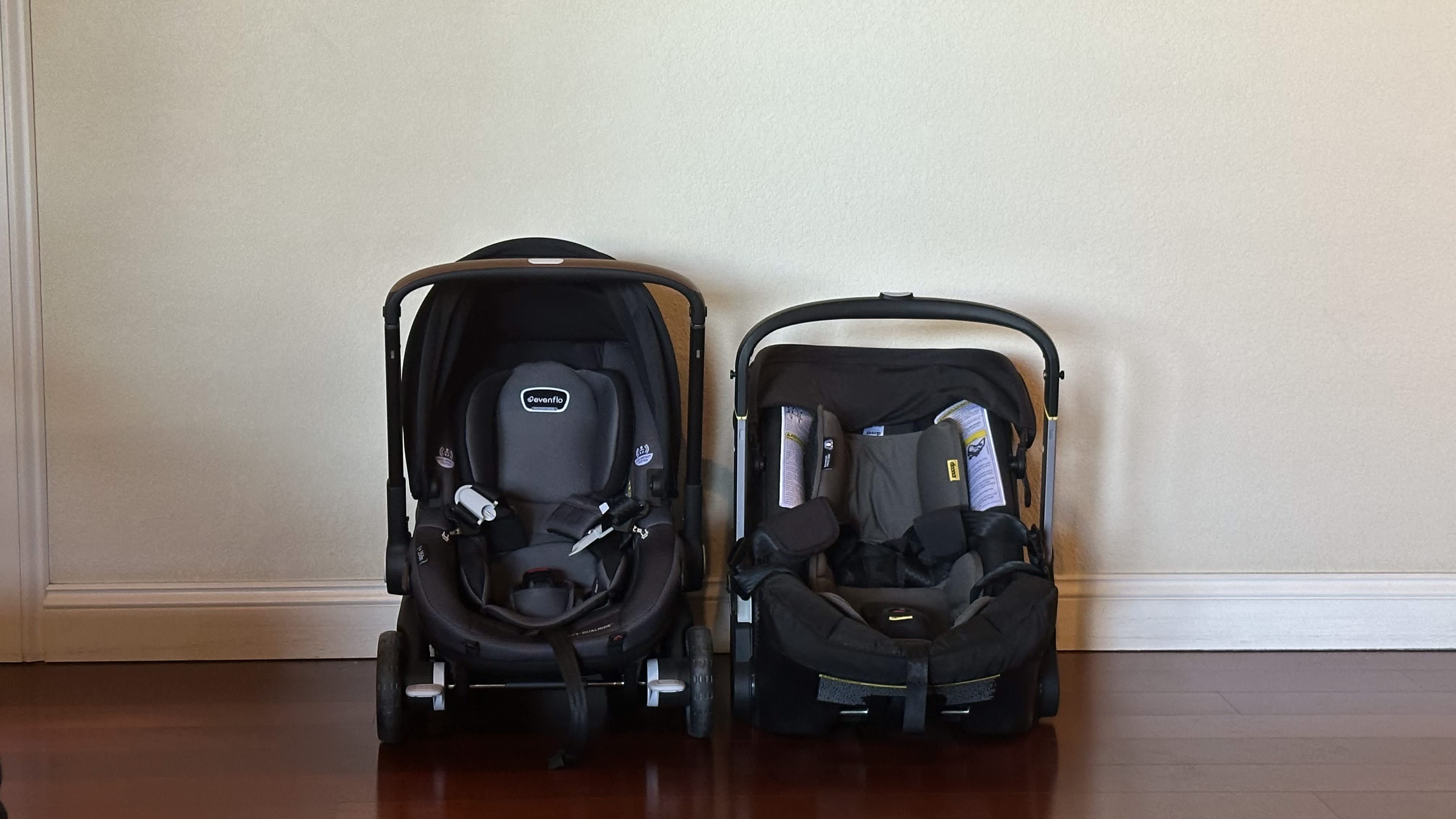
The Evenflo Shyft DualRide (left) and the Doona (right) side by side for size comparison.
Doona vs. Evenflo Shyft DualRide: Installation & Safety
Installation & Safety: What’s similar
Both the Doona and the Shyft DualRide can be installed in a vehicle with or without the base, and the base can be installed via LATCH or seat belt. Both bases have anti-rebound technology for extra safety, though neither have load legs or rigid LATCH.
Both systems are fairly quick and easy to install, regardless of which installation method you choose—though some parents have found the Shyft DualRide was a bit confusing at first. And both seats are FAA-approved for use on airplanes as well.
If you’re hoping to fit three of these car seats in your vehicle’s back seat, you’ll need to install them without their bases (i.e. using just the vehicle’s seat belts; no LATCH system), since neither the Doona’s base nor the Shyft DualRide’s base is slim enough to fit directly side-by-side. But without the base, it’s possible to get three seats together in many cars.
Installation & Safety: What’s different
Even though both systems allow for the same installation methods, the Shyft DualRide can only be installed with the base when the stroller frame is attached; the carrier alone can’t connect to the base.
The Evenflo Shyft DualRide comes standard with SensorSafe technology, which alerts parents of potential safety concerns like an unbuckled chest clip, unsafe temperatures, if your child is in their seat for too long or if they’re left unattended.
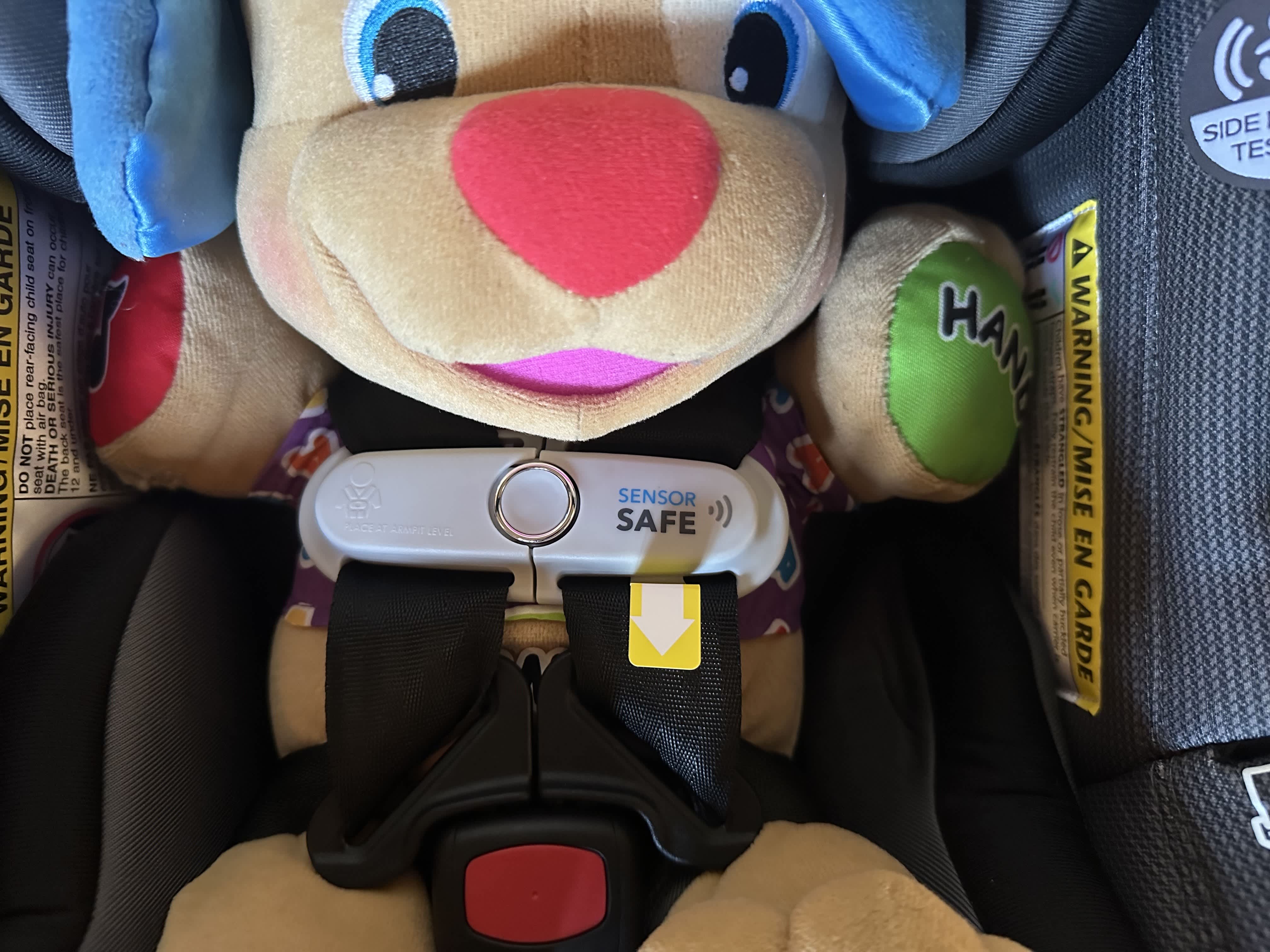
The Shyft DualRide includes a SensorSafe bluetooth safety alert chest clip in every model.
The Doona doesn’t include safety sensors in the standard model, though there is an option to bundle your Doona purchase with SensAlert. Unlike Evenflo’s SensorSafe technology, Doona’s SensAlert only notifies you when your child is left in a vehicle unattended; it doesn’t alert you to any other safety concerns.
Another key safety difference is the harness: the Shyft DualRide has a no-rethread harness for faster height adjustments, while the Doona requires manual rethreading as baby grows. Additionally, the Doona’s harness has 3 height levels; the Shyft DualRide’s harness has eight height levels, giving your baby a more tailored fit.
There are pros and cons to each of these: the Shyft DualRide’s no-rethread harness is quicker and easier, but with smaller height increments, you’ll be adjusting it a lot more often; on the other hand, the Doona’s manual rethread harness is more complicated (and often frustrating), but you’ll only need to mess with it once or twice for the entire time your baby fits in the seat. Both harness adjustment types are considered equally safe.
Doona vs. Evenflo Shyft DualRide: Suspension & Maneuverability
Suspension: What’s similar
Both of these all-in-one travel systems work best on smooth, paved terrain like sidewalks or store aisles. And since they’re fairly lightweight compared to a full-size stroller, they’re easier to maneuver when you need to make a quick pivot or a sudden stop. They’re ideal for outings where agility matters more than durability, and since neither stroller frame has any real suspension to speak of, they simply don’t match the performance of a full-size stroller for outdoor adventures. Not to mention that, for longer outings, a full-size stroller with a lay-flat option is safest for when baby needs to nap—neither of these systems are considered a safe sleep space for baby.
Suspension: What’s different
While my testing found that neither system is ideal for rougher terrain, the Doona struggled more on uneven surfaces like grass and bumpy gravel, and it was a literal no-go on sand. The Shyft DualRide performed a smoother ride over varied terrain (including broken sidewalks and tree roots) and was able to handle sand slightly better.
The stroller frames also differ in their braking systems. The Doona has one pedal for engaging the brake and a second pedal for disengaging the brake. The Shyft DualRide also has two pedals, but both function independently, and both need to be used in order to fully engage and disengage the brakes. Many parents have mentioned the Shyft DualRide’s dual-pedal braking system as a huge negative—I personally didn’t care for either of the brands’ brake functionalities, but the Shyft DualRide was the more irritating (especially in flip-flops).
The Doona's braking system: green pedal (left) to release brake, red pedal (right) to engage brake.
Doona vs. Evenflo Shyft DualRide: Extra Features & Accessories
Accessories: What’s similar
Each system is compatible with accessories like storage bags, cup holders, rain shields and travel bags.
Accessories: What’s different
The Shyft DualRide packs in more features right out of the box, even with the base model. It includes a parent cup holder, built-in buckle holders to keep harness straps out of the way and the SensorSafe technology mentioned before. There’s also another version that comes with the storage bag included (which I received to test); the Doona's storage bag needs to be purchased separately (which I didn't receive for testing).
The Doona's storage bag attaches at the back of the seat behind baby's head, and the Shyft DualRide's storage bag attaches just below baby’s feet. They’re both pretty roomy—enough to fit a small backpack or purse, a portable diaper changing pad, a full-size water bottle and a toy or two. You can see the Shyft DualRide storage bag’s roominess demonstrated below; the downside to this one being that you might end up kicking the storage bag as you walk, and the placement can make accessing the brake pedals a challenge.
The Shyft DualRide's storage bag hooks onto the carrier under baby's feet and can hold a lot of essentials.

The Shyft DualRide's built-in buckle holders to keep harness straps out of the way.
For the Doona, almost all accessories are sold separately (except for a vehicle seat protection mat)—though the Doona does have more accessories available than the Shyft DualRide, including a handlebar cover, an insect net and several different styles of storage bags.
Doona vs. Evenflo Shyft DualRide: The Bottom Line
If you’re set on getting a car seat-stroller combination system, then both of these options are solid picks. But the right one for you depends on your specific needs.
Choose the Doona if you want more streamlined functionality with the fold and braking system, a better fit for a newborn and a lighter weight option overall (when bases are included, the Doona is about 10 pounds lighter than the Shyft DualRide). It’s perfect for travel or quick errands, and has a slightly easier time fitting into tight spaces—though you’ll want to avoid rougher terrain and factor in the cost of add-on accessories.
Opt for the Evenflo Shyft DualRide if you want more built-in features right away. The Bluetooth safety sensor and detachable carrier make it a great choice for parents who prioritize convenience and peace of mind. You might also consider it if you’re planning to traverse more varied terrain.
