
Your 46-Week-Old Baby
Is it time to move baby to their own room? Here's expert guidance on room-sharing and when (or if) to make the transition.

By

If you've been room-sharing with your baby since birth, you might be wondering when it's time to move them to their own room—or if you even need to. I talked to two experts about what the American Academy of Pediatrics (AAP) recommends, why room-sharing offers safety benefits, and what parents should keep in mind when deciding whether (and when) to make the move.
🚼 Baby’s Development
When (and if) to move baby to their own room
The short answer to this common question is: there's no rush, and the decision is ultimately up to you.
A quick terminology note: Room-sharing means your baby sleeps in your room in their own safe sleep space—a crib, bassinet, or bedside sleeper. Bed-sharing, on the other hand, means your baby sleeps in your bed with you, which significantly increases the risk of SIDS and sleep-related accidents. This is why professionals and experts do not recommend it.
Dr. Chris Klunk, a board-certified neonatologist at Pediatrix Medical Group, points to the AAP's guidance on room-sharing for at least the first six months, which has been linked to a lower risk of SIDS. He's quick to note that the benefit is specific to room-sharing—not bed-sharing—and the two shouldn't be confused with one another. If room-sharing is working well for your family beyond the six-month mark, there's no harm in continuing; some families room-share well into toddlerhood.
On the flip side, if your baby (or you) isn't sleeping well because of room-sharing—maybe every little noise wakes them up, or you're lying awake listening to every grunt and wiggle—it might be time to consider transitioning them to sleeping in their own room, especially if your baby is past the six-month mark.
The bottom line: room-sharing offers safety benefits, especially in the first six to 12 months. After that, the decision is about what works best for your family's sleep and wellbeing.
Making the transition smooth
If you've decided it's time to move your baby to their own room, the good news is that many families find the transition goes more smoothly than expected.
Lauren Ketting-Olivier, a certified pediatric sleep consultant and founder of Tiny Stars Sleep, recommends starting gradually. "[Practice] sleep in the crib for the first nap of the day for a few days leading up to the transition," she says. Then, "When parents are ready to fully move baby into their own room, bedtime is often the best place to start since melatonin production is naturally highest then, which can make the transition feel smoother."
Once you've made the move, consistency is key. "Going back and forth between sleep spaces can create confusion," Ketting-Olivier explains, "so I encourage families to give their child time to build familiarity and comfort in the new environment." Some families also find it helpful to use a crib sheet that smells like them to provide additional reassurance.
As for the actual transition, you might be pleasantly surprised. "Many families are surprised to find that sleep either stays the same or improves after moving baby into their own room," Ketting-Olivier says. "Without realizing it, parents can sometimes disturb [baby's] sleep through movement [or] noise." And that goes both ways. Your sleep as a new parent may improve because they're not hearing every little movement or baby grunt
What if your baby protests or struggles with sleeping alone? Even babies who were previously falling asleep independently can feel a little thrown off by a new sleep environment at first, and some temporarily protest the crib or need extra support. A brief return to familiar comfort (elements of what you were doing before) helps rebuild their confidence in the new space and cuts down on the initial resistance.
From there, most families can reintroduce independent sleep more smoothly, since baby feels more settled and secure in the crib again. If baby's protest is milder, crib-side support (staying nearby while baby settles, without fully holding them to sleep) can work just as well. How much support baby needs really depends on the child and how strongly they're protesting the change.
If neither approach feels like the right fit, or if baby needs more consistent help falling asleep on their own, check out our guide to starting a bedtime routine for additional strategies.
And remember: safe sleep practices stay the same, wherever baby sleeps. Dr. Klunk's guidance holds regardless of the room: put baby on their back to sleep, don't put anything besides a fitted sheet in the crib and make sure their room is a comfortable temperature. He also recommends babyproofing the area around the crib—and the room as a whole—since cords or blind pulls can become a hazard once baby is mobile.
🛍️ Panic Order
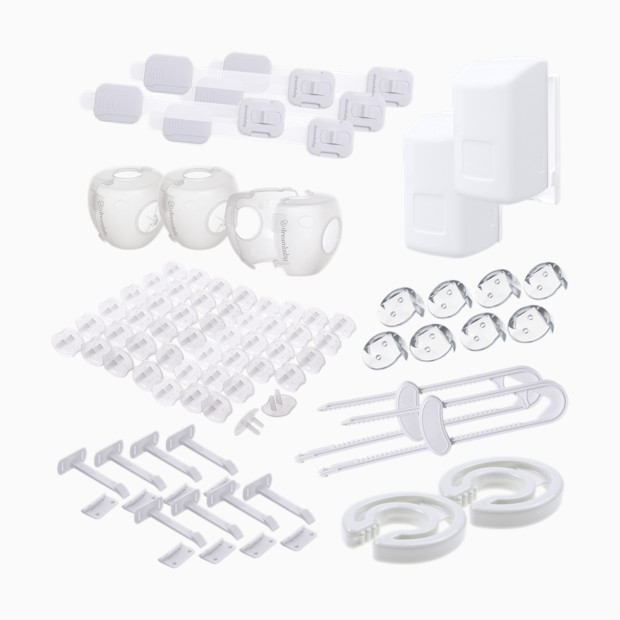
If you didn't get a monitor or a baby proofing kit for your baby's nursery just yet, now's the time.



👀 Looking Ahead
Independent play + problem-solving: Your baby is starting to explore and entertain themselves for short stretches—and that's a great thing. Next week, we'll cover what independent play looks like at this age, how to encourage it (without the guilt) and which toys support problem-solving and fine motor skills.
Expert Sources
Babylist content uses high-quality subject matter experts to provide accurate and reliable information to our users. Sources for this story include:
Lauren Ketting-Olivier, certified pediatric sleep consultant and founder of Tiny Stars Sleep
Dr. Chris Klunk, board-certified neonatologist at Pediatrix Medical Group

;)
;)
;)