
6 Daycare Drop-Off Tips That Actually Work, From Parents Who've Been There
From goodbye rituals to managing your own emotions, here's how to make daycare transitions smoother for everyone.

By
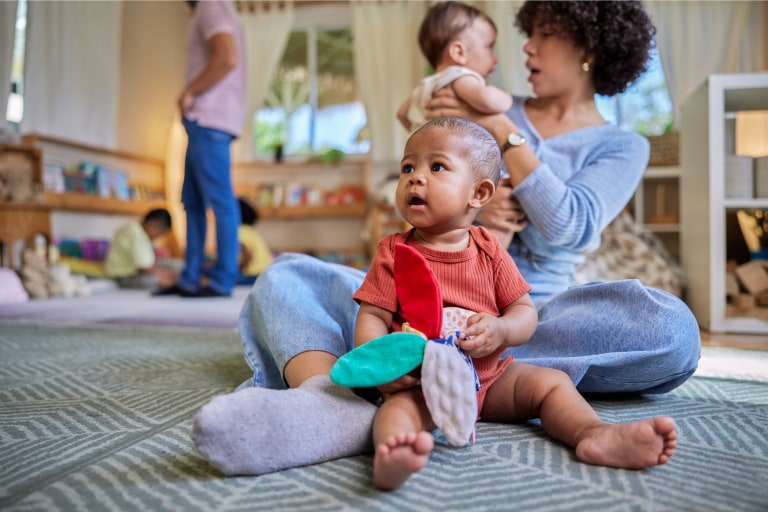
The first day of daycare can feel like a leap into the unknown. You’ve packed the tiny backpack, labeled every bottle and blanket and talked about all the fun they’ll have. Still, the thought of handing your baby over to someone else—whether they’re just a few months old or well into toddlerhood—can tug at your heart in unexpected ways.
I’ve been on both sides of this moment: as a preschool teacher and as a parent of two, smiling through my own misty goodbyes.
With the right preparation, there are a few things you can do to make starting daycare a little easier for everyone.
I talked to Michelle Charriere, an infant mental health expert and founder of Babies and Brains, a platform that supports children’s social-emotional development and helps parents build strong attachment, for tips to help the transition go smoothly. We also asked real Babylist parents in our newsletter what actually works for them at drop-off, and their tips are ones you’ll definitely want to save for later!
Tips for Easier Daycare Drop-Offs
Here’s how Babylist parents keep transitions and drop-off as smooth as possible:
#1 Always say goodbye
As tempting as it can be to sneak out once your little one seems occupied with an activity, saying goodbye helps build trust. They need to know you’ll always return.
One Babylist parent who works in early childhood put it well: "Lingering as they cry or disappearing while their back is turned creates an anxious attachment instead of a secure one."
The goal is a confident, loving goodbye—one that tells your child: I love you and I'll be back. Another parent shared, “Promising that we will always come back and leaving on a positive note helps remind him we aren't abandoning him. Plus then he gets excited to see us when we come back.”
#2 Keep it short and upbeat
Lingering too long can sometimes make it harder for your child to settle, but that also doesn’t mean you need to do a swift “drop and go”.
One early childhood educator and daycare mom put it plainly: "99% of the time they're fine once you leave. Staying to 'comfort' them just makes it worse."
Try to create a short and sweet routine that ends with a confident goodbye. In my classroom, we had a sequence of events that created a “drop-off routine”, and it was no more than two minutes. The families would arrive, put their little one’s backpacks in their cubby and then wash hands together before handing them off to the teacher and saying goodbye.
“I've found it helpful to make it a quick separation, and the teachers are great at supporting this. I say goodbye, give him a quick kiss,” says Cassie, a mom of a four- and two-year-old, who both started daycare around five and a half months old. Many parents echoed the same instinct. "Don't linger out of guilt when they cry at drop-off," one mom wrote in our poll.
Having been in the classroom, soothing toddlers at drop-off, I can assure you: most little ones calm down within a minute of their caregiver leaving. We always had a plan to call families if a child truly couldn’t settle—but in all my years, I never actually had to make that call.
Another parent who has experience working in a daycare backs this up. “I know how quickly tears usually dry up once parents leave and how sticking around usually just prolongs the sadness. I just give some quick kisses or a hug, say ‘bye, love you baby, mommy will see you later’ and dash away.”
#3 Create a special goodbye ritual
Whether it’s a hug and a phrase you repeat (like “see you after snack time”), that consistency and predictability goes a long way to making little ones feel secure in their surroundings. Saying see you later is also a good way to bridge the time apart, holding them over until pick up time and reinforces that you’ll be back.
Parents shared a bunch of sweet ideas in our poll, here are a few they came up with:
A goodbye song: "We have a song we always sing as I'm getting my little one out of the car seat. If I ever forget, she won't let go of my leg until we sing."
The window moment: "Her room has a window. When I leave, we each put our hands on the window and blow a kiss—a little last goodbye before she runs off to play."
The belly button boop: "Belly button—push it when you miss me and I'll feel it too. It's how we were connected in the womb."
An ear nibble: “My daughter usually insists on [a] hug, kiss and "eat ear" (we nibble on each ear), so she knows what to expect.”
An exciting high five: “Give the same fun goodbye each morning—a hug, a kiss, and a high five that she can't wait for!”
#4 Hand them off to the same caregiver if you can
Most daycare centers should have a consistent staff schedule, which allows for predictability in who you’ll be handing off your child to. Talk to the teachers and see if it’s possible to have the same caregiver welcome them at drop off. Depending on how many kids are arriving at the same time, it might not always be feasible but it can definitely help. And a familiar face doesn't have to mean a teacher—sometimes it's a friend. One parent shared, "Instead of handing her to the teacher, I place her on the mat next to a friend so she sees a toy or a classmate as I'm leaving." Either way, the handoff goes smoother when your child has something—or someone—to turn toward.
#5 Ease into daycare with shorter days at first
If your center allows it, start with short visits and gradually lengthen the day—this kind of warm-up period can make a big difference. Charriere also recommends “easing in” with shorter visits until your child is more comfortable. When I was teaching, this was built into the schedule during intake sessions with new families: we’d plan for earlier pickups the first two or three days, then gradually extend the time over the course of the week.
Several parents I spoke to shared how helpful this kind of transition was for their families. Brooke, a mom of one, said, “A week before we started at daycare, we did ‘practice runs,’ where we dropped him off for a few hours instead of a full day.” Caitlin, mom of a soon-to-be one-year-old, shared, “We did a practice session for [about] 90 minutes where I stayed. She got to be in the room around the other kids and teachers, so there was at least a little familiarity for her first real day.”
Check with your daycare provider to see if a gradual start is an option. It can help your child ease into the new environment without becoming overwhelmed.
#6 Remember: you’re adjusting right along with them
Something that kept coming up in our poll (almost as a micro trend) were tips focused on the parent's own emotional state, not just the child's. Turns out, how you show up at drop-off matters more than you might think.
“If your child is attached to one parent more, have the other partner do drop offs (if possible). It reduces adding more emotional weight to the situation.”
“Have the husband do drop offs for the first two months LOL. But really, get to know the teachers—it’s not their first rodeo, and they’re used to new parents struggling with those first couple months especially.”
“Talk to the other parents: it’s a great way to make new friends and feel part of a community. Parents with older kids give good advice, too!”
“Keep mornings calm. I notice when I rush getting out the door drop offs are hard.”
“Leave earlier than I need to so I’m not rushing. My anxious energy would make him more clingy.”
“Making sure they’re in a good mood (and yourself) helps make the association a positive one.”
"I do a grounding exercise after I leave and I am back in my car. I put my hand on my heart and take 3 deep breaths. Then I remind myself of these things: 1) It's okay to feel love and sadness at the same time. 2) My baby is safe and loved. 3) I choose to work so our family can have the life that we want."
Give yourself the same compassion and patience you're giving your child.
Know What’s Happening Developmentally
If you’re anything like me, understanding a bit about what’s going on behind the scenes of this transition can help ease the anxiety you may be feeling.
Attachment
Starting daycare isn’t just a change in routine—it’s a big emotional shift for your child and for you. Knowing what’s behind those tears (or clinging hugs) can help you respond with empathy and patience.
In the early years, your child’s main sense of safety comes from their attachment to you. “When we encounter change or something novel in our environment, we are ‘on alert’ in case this change comes with danger. A secure attachment relationship helps the child feel safe to explore new things and know that if they need protection, they can seek it out from their trusted caregivers,” says Charriere. When they feel secure with you, they’re better able to build trust with other caregivers—like their new teacher.
Learning to connect with another caregiver is an important step in their social-emotional development. It builds resilience, supports emotional regulation and expands their sense of safety beyond home. “To maintain security during this transition, it’s important for parents to continue attuning to their child’s needs, honoring the child’s emotional experience and supporting their feeling of safety in exploration,” Charriere adds. “And repair when we get off track—because we’re human.”
A note on separation anxiety…
Separation anxiety often peaks between 8 and 18 months but can show up well into toddlerhood, especially during transitions. Some children may be hesitant with new people and surroundings from day one, while others seem fine at first (the “honeymoon phase”) and then struggle after a week or two once they realize the change is here to stay. Both are normal.
In the US, babies whose parents take parental leave often start daycare between four and six months—right around the time separation anxiety begins to emerge. Around six months, babies understand that you exist even when you’re out of sight (object permanence), but they don’t yet know you’ll always return. This can make goodbyes especially tough.
You set the tone
Babies and toddlers often take emotional cues from their caregivers. So trying to remain calm can help your child mirror that emotion. “It’s not about having zero anxiety before a big transition—that’s so normal—but it is something we want to be mindful of,” Charriere says.
When and How to Start Preparing for Daycare
Babies and toddlers are super observant (even if they’re not yet verbal), so it’s helpful to start preparing them a few weeks before their first day. Charriere says if you start touring centers or buy them their first backpack, “their little gears may already be turning, trying to figure it out.”
Start introducing the idea by talking with your baby or toddler about going to school, what their day may look like and who their teacher is. I also recommend taking them along to visit their new daycare (or “school” as we called it) so that it’s not totally brand new on their first day.
Here are a few ways to help your child feel more comfortable:
Introduce a comfort item. Emily, a mom of two, shared, “With one of ours who was a little clingier—about 26 months old—we got a special object, a Jellycat bunny. It lived in their backpack and came out at school as their ‘school bunny.’ It didn’t replace their favorite stuffed animals at home, but it was something special they only had at school.” Another parent who responded to our poll said they introduced a special blanket, “Every time I bring it home to wash, I spritz it with my perfume so it smells like mama!” (Just make sure your center allows these kinds of items.)
Keep familiar routines. Whether it’s morning snuggles or a special song, sticking with your normal routine helps children feel grounded. Knowing what comes next can ease anxiety.
Talk positively about daycare during playtime. You can say things like, “Your new teacher will love reading books with you!” or make up a simple social story about your child’s daycare routine—who their teacher is, what they’ll do and when you’ll pick them up. You don’t need spectacular artistic skills or anything fancy to make this work.
Read books about daycare transitions. Stories like The Kissing Hand, Llama Llama Misses Mama and Bye-Bye Time help little ones understand what’s coming next.
Try pretend play. Charriere also recommends role-playing with your child’s favorite stuffed animals to help them explore and express feelings about the change. It’s a gentle, low-pressure way to work through new routines together.
Here are a few things to get you and your little one ready for their first day:







What to Expect in the First Few Weeks
Many parents might wonder how long the tough part will last. Every child is different, but for most families, it takes a few days to a couple of weeks to fully adjust. Having consistent drop-offs and staying in communication with your provider can help smooth the process.
Ultimately, even when you do everything “right,” there may still be tears—and that’s okay. According to Charriere, what’s most important isn’t whether your child cries at drop-off, but whether the caregiver can confidently soothe them and your child feels secure enough to explore and return for support when they need it.
So much depends on your child’s temperament and their stage of development, especially when it comes to separation anxiety. The most important thing is to give both yourself and your baby the space and time to adjust. With consistency, support and a little patience, it will get easier!
Expert Sources
Babylist uses high-quality subject matter experts to provide accurate and reliable information to our users. Sources for this story include:
Michelle Charriere, an infant mental health specialist and founder of Babies and Brains.

;)
;)
;)
;)
;)
;)
;)
;)
;)