Pregnancy due date calculator
Find your estimated due date, see how far along you are and know which trimester you're in. Calculate from your last period, conception date, IVF transfer, ultrasound or current week of pregnancy.
This is a sample result. Enter your own dates above to calculate your due date.
How far along are you? Find your week, month, and trimester
You're week 6, in your 2nd month, in the 1st trimester.
| Weeks | Dates | Month | Trimester | Current stage |
|---|---|---|---|---|
| 1–4 | Sep 8 – Oct 12, 2026 | Month 1 | First | |
| 5–8 | Oct 13 – Nov 9, 2026 | Month 2 | First | You are here |
| 9–13 | Nov 10 – Dec 14, 2026 | Month 3 | First | |
| 14–17 | Dec 15, 2026 – Jan 11, 2027 | Month 4 | Second | |
| 18–22 | Jan 12 – Feb 15, 2027 | Month 5 | Second | |
| 23–27 | Feb 16 – Mar 22, 2027 | Month 6 | Second | |
| 28–31 | Mar 23 – Apr 19, 2027 | Month 7 | Third | |
| 32–35 | Apr 20 – May 17, 2027 | Month 8 | Third | |
| 36–40 | May 18 – Jun 15, 2027 | Month 9 | Third |
Calendar dates are based on your estimated due date and update as you change your inputs.
How big is your baby right now?
In weeks 5–8, your baby grows from about the size of a Pop Rocks crystal to a bike spoke bead.
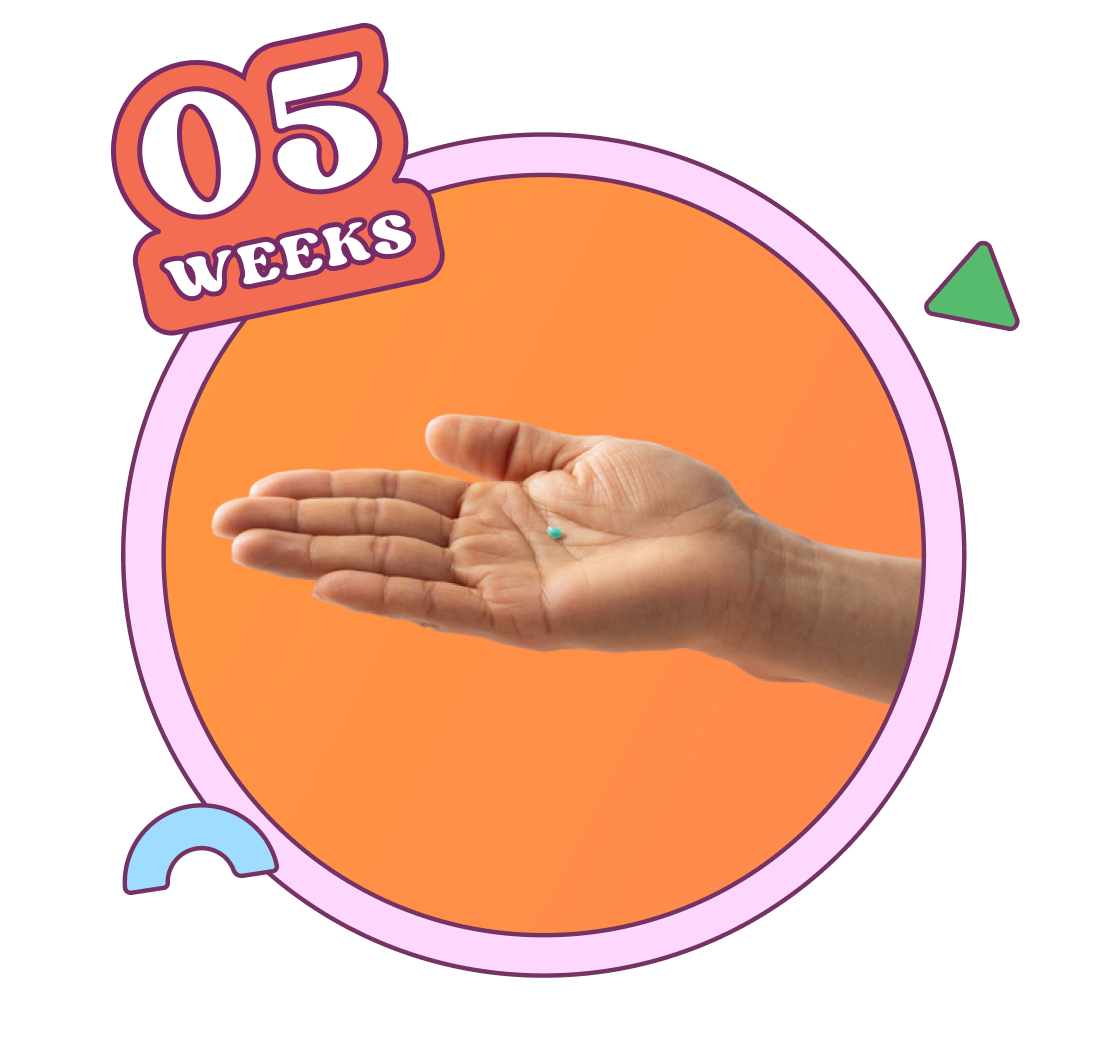



From Babylist's week-by-week guides
Common questions
How do I use this calculator?
How is my due date calculated?
How is the date of conception calculated?
How is a due date estimated from an ultrasound?
How is an IVF due date calculated?
What if I already know my due date?
Can my due date change?
How likely am I to give birth on my due date?
How soon can I take a pregnancy test?
Why did Babylist make this due date calculator?
What month of pregnancy am I in?
| Weeks | Month |
|---|---|
| 1–4 | Month 1 |
| 5–8 | Month 2 |
| 9–13 | Month 3 5 weeks |
| 14–17 | Month 4 |
| 18–22 | Month 5 5 weeks |
| 23–27 | Month 6 5 weeks |
| 28–31 | Month 7 |
| 32–35 | Month 8 |
| 36–40 | Month 9 5 weeks |
Most months have 4 weeks, but months 3, 5, 6, and 9 have 5. That's why the table doesn't divide evenly. Pregnancy is measured in weeks and trimesters, so these month groupings are an approximation.[1] Quick reference: 12 weeks is about 3 months, 20 weeks is about 5 months, 28 weeks is about 7 months, 36 weeks is about 9 months.
Estimated due date by conception month
Your estimated due date is about 38 weeks (266 days) after the day you conceived.
Last updated October 2026 · Previous 10 months.
| If you got pregnant in | Estimated due date |
|---|---|
| September 2026 | May 2027 |
| August 2026 | April 2027 |
| July 2026 | March 2027 |
| June 2026 | February 2027 |
| May 2026 | January 2027 |
| April 2026 | December 2026 |
| March 2026 | November 2026 |
| February 2026 | October 2026 |
| January 2026 | September 2026 |
| December 2025 | August 2026 |
The math behind due date estimates
How your due date is calculated
ACOG dates a pregnancy by adding 280 days (40 weeks) to the first day of your last period — a method called Naegele's rule.[1] Gestational age is counted from that first day, while fetal age starts about two weeks later, at conception.[5]
Trimesters
The first trimester is weeks 1–13, the second is weeks 14–27, and the third is weeks 28–40. ACOG defines full term as 39–40 weeks, early term as 37–38 weeks, late term as 41 weeks, and post-term as 42 weeks or more.[2]
Ultrasound vs. last period — which date is right?
ACOG considers a first-trimester ultrasound the most accurate way to date a pregnancy.[1] If an early dating ultrasound disagrees with your last-period date, your provider re-dates by the ultrasound only when the gap is large enough. Per ACOG Committee Opinion 700:
| Gestational age at scan | Re-date if the dates differ by |
|---|---|
| Up to 8 weeks 6 days | More than 5 days |
| 9w 0d – 15w 6d | More than 7 days |
| 16w 0d – 21w 6d | More than 10 days |
| 22w 0d – 27w 6d | More than 14 days |
| 28 weeks and beyond | More than 21 days |
Once an early scan sets your due date, later scans generally shouldn't override it.
Understanding pregnancy dating terms
- LMP (last menstrual period)
- The first day of your last period. ACOG counts your due date from this day, even though conception happens about two weeks later.[1]
- EDD / EDC (estimated due date / estimated date of confinement)
- Your baby's estimated arrival, 280 days after your LMP. EDD and EDC mean the same thing.
- Gestational age vs. fetal age
- Gestational age is counted from your last period; fetal age from conception, about two weeks later. That is why you are "4 weeks pregnant" about two weeks after conception.[5]
- DPO (days past ovulation)
- Days since you ovulated. Because ovulation is close to conception, N DPO is about N + 14 days of gestational age.
Explore week by week








Never miss a milestone
Sign up to get week-by-week updates about your pregnancy, including common symptoms and baby's development during each pregnancy trimester.
Free checklists and templates



References
- American College of Obstetricians and Gynecologists. Committee Opinion No. 700: Methods for Estimating the Due Date. Obstet Gynecol. 2017;129(5):e150-e154. https://www.acog.org/clinical/clinical-guidance/committee-opinion/articles/2017/05/methods-for-estimating-the-due-date
- American College of Obstetricians and Gynecologists; Society for Maternal-Fetal Medicine. Committee Opinion No. 579: Definition of Term Pregnancy. Obstet Gynecol. 2013;122(5):1139-1140. https://www.acog.org/clinical/clinical-guidance/committee-opinion/articles/2013/11/definition-of-term-pregnancy
- National Center for Health Statistics. Births: Final Data for 2023 (NCHS Data Brief No. 507). CDC; 2024. https://www.cdc.gov/nchs/products/databriefs/db507.htm
- National Health Service. Due date calculator. NHS. https://www.nhs.uk/pregnancy/finding-out/due-date-calculator/
- MedlinePlus. Gestational age. National Library of Medicine. https://medlineplus.gov/ency/article/002367.htm
- Jukic AMZ, Baird DD, Weinberg CR, McConnaughey DR, Wilcox AJ. Length of human pregnancy and contributors to its natural variation. Hum Reprod. 2013;28(10):2848-2855. https://academic.oup.com/humrep/article-abstract/28/10/2848/620772
