
The Best Bouncers and Swings to Get Your Baby to Chill
Rest your arms—and maybe even take a shower!—while your baby is safe and entertained.

By
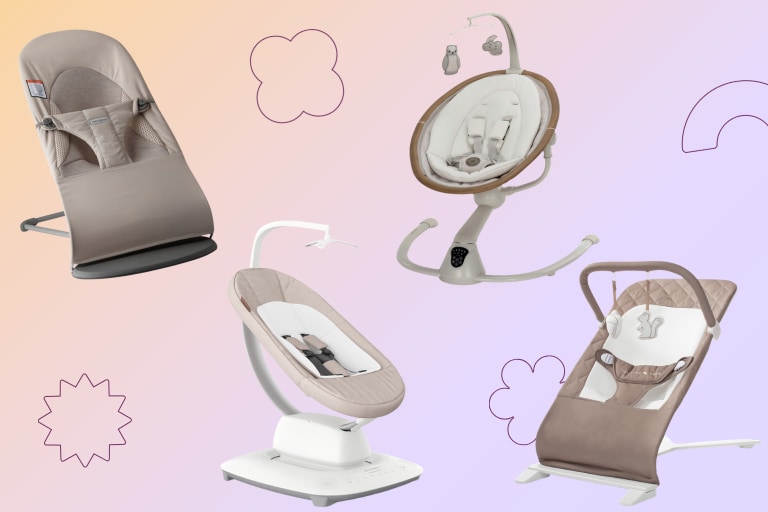
Although your baby may disagree, it’s not practical to think you’ll be able to hold your newborn all day long. At some point you’ll need a shower, a meal or just a minute to sit down, and that’s where baby bouncers and swings come in. As Babylist’s senior gear editor and a mom of two myself, I’ve tested countless swings and bouncers—and heard feedback from thousands of new parents—and my pick for the best baby bouncer overall is the BabyBjörn Bouncer Balance Soft. It’s responsive to your baby's movements, easy to clean and folds flat for storage.
The best baby swing overall is the Maxi-Cosi Cassia, a pick that’s as stylish as it is functional. And if you’d like to shop a few more choices, I’m breaking down my other top picks below, including tech-forward smart options, value picks and swings and bouncers for small spaces.
How We Judged the Best Baby Bouncers and Swings
Baby Bouncers
Best Baby Bouncer Overall
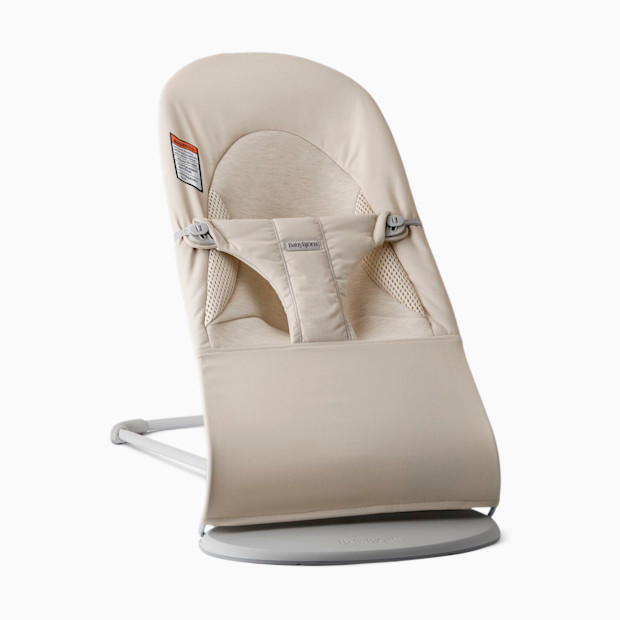
BabyBjörn Bouncer Bliss - Cotton/Jersey/Mesh Light Beige
From $223.99Pros
- Most-loved bouncer in Babylist's annual parent survey
- Supportive enough for newborns, no insert needed
- Responsive even to small movements
- Lightweight, folds flat
Cons
- Expensive
- Toy bar sold separately
TL;DR
A lightweight, newborn-ready bouncer that’s exceptionally supportive, responsive and easy to move around the house. It’s pricey, but its smart design, long lifespan and everyday usefulness make it worth the investment.
At first glance, this bouncer doesn’t look like much, and for a new parent who’s never used one before, it can be hard to understand the hype. But trust me on this one: the BabyBjörn Bouncer Balance is hands-down the best baby bouncer overall and worth the investment. It nails the things that matter most—newborn support, responsiveness and portability—and it’s one of the few pieces of baby gear I tell almost every expecting parent to register for.
This classic bouncer (the first version launched in 1961) combines ergonomic, newborn-ready support with an ultra-lightweight, fold-flat design. I used it daily with both of my boys, whether I needed a break, a shower or somewhere to put my newborn during family dinner, and they were both comfortable and almost always soothed by it. It also has the perfect level of “bounce.” The seat responds to even the slightest movement (unlike many bouncers that take more effort to get going), so even young babies can quickly catch on.
At just under seven pounds, it folds flat in seconds, so I could tuck it behind a door, drag it from room to room or toss it in the car without a second thought. There are three recline positions to accommodate different ages and stages, and once your baby outgrows the bouncer, you can reverse the fabric and use it as a toddler chair. And if the upright position makes your baby poop (it’s a thing!), don’t stress—the entire fabric seat slides off in seconds and goes straight into the washing machine.
Babylist parents are on board, too, voting the Balance as their most-loved baby bouncer year after year in our annual Most Loved Baby Products survey. “It’s a total game changer,” noted one parent. “Who knew 15-20 minutes of being hands-free could be so life-changing,” added another. “It’s worth the money—I get it now.”
Worth noting:
While extremely responsive, the bounce is powered by your baby’s movement, so you’ll need to manually bounce the seat until your little one is big enough to get it moving on their own.
It’s one of the pricier bouncers on the market, and the toy bar is sold separately, adding to the overall cost. The longer lifespan helps offset the price, though.
Keep an eye out for a new addition from BabyBjörn: the Bouncer Begin. It’s designed especially for the newborn phase, with an extra-supportive seat and easier buckles.
Additional Specs
Child Guidelines: As a bouncer, birth (minimum weight 8 lbs) to when baby sits up unassisted; as a chair, up to 2 yrs or 29 lbs in the most upright position
Plugs or Batteries: None; uses baby's movements
Best Value Baby Bouncer
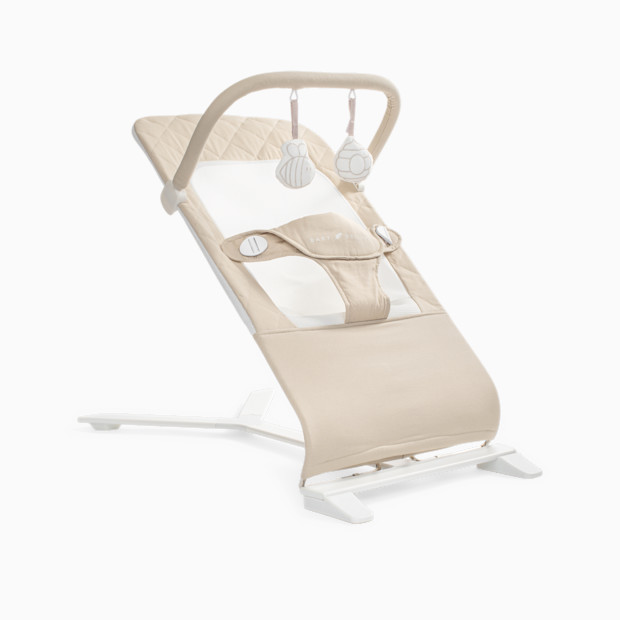
Baby Delight Alpine Organic Deluxe Portable Bouncer - Organic Oat
From $69.99Pros
- Affordable
- Lightweight, folds flat
- Toy bar and carry bag included
Cons
- Not as bouncy as pricier options
- Fit can run loose on smaller babies
- Requires assembly
TL;DR
An ultra-affordable, lightweight bouncer with the same fold-flat portability as pricier picks, plus a toy bar and carry bag thrown in. It's a little less bouncy and needs some assembly, but it's a smart choice if you're value-conscious.
If you love the look of the BabyBjörn but not the price tag, the Baby Delight Alpine is our pick for the best affordable baby bouncer and the one I point budget-conscious parents toward. It has a similar silhouette and the same three recline positions, and at just over four pounds, it's actually lighter and even easier to fold flat and carry room to room. The seat cover unzips and machine washes, which matters more than you'd think once spit-up enters the picture.
“It has been our baby's favorite place besides our arms,” said one parent in our annual survey. “It was a lifesaver in the newborn stage to keep my baby upright when we were battling reflux,” noted another.
Worth noting:
The main difference I’ve found between the BabyBjörn, our best overall pick, and this bouncer is responsiveness: it takes a bit more of a nudge to get this one moving. It’s not a dealbreaker for me, especially considering the price difference, but it is something to note. It also has more plastic components than the Balance Soft.
This bouncer arrives unassembled, so budget a few minutes with the instructions before your baby can use it.
The harness isn't adjustable, so it can sit a little loose on smaller newborns.
If you want to spend even less, or need an extra bouncer for the grandparents’ house, the Bright Starts Safari Fun Vibrating Bouncer ($29.99) adds battery-powered vibration and two toys, though it's built for a shorter age range (birth to six months) and doesn't fold as flat.
Additional Specs
Child Guidelines: Birth to 6 mos or up to 20 lbs
Plugs or Batteries: None; uses baby's movements
Longest Lasting Baby Bouncer
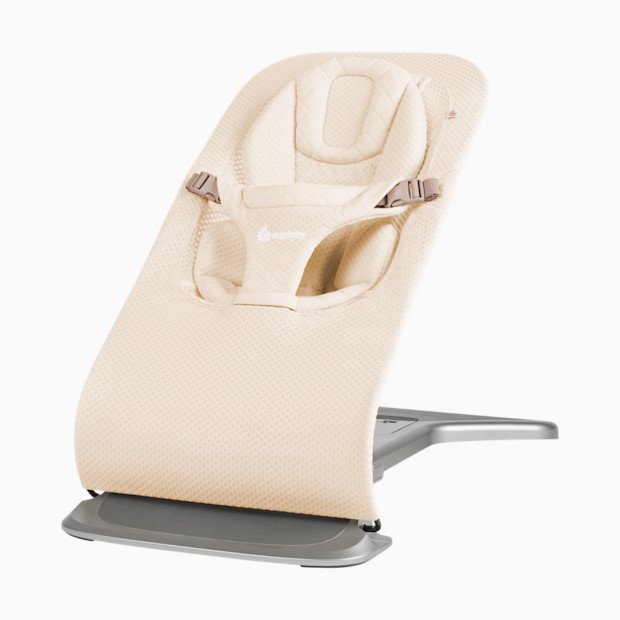
Ergobaby Evolve Bouncer - Cream Mesh
From $199.00Pros
- Grows with baby from newborn to toddler (5.5-29 lbs)
- Certified hip-healthy; developed with a pediatric orthopedist
Cons
- Larger footprint than other bouncers
- Heavy (~8 lbs)
- Toy bar sold separately
TL;DR
A newborn-ready bouncer designed to grow with your baby all the way through toddlerhood, with real orthopedic input behind the design. It takes up more floor space than other options, but the extended lifespan makes it worth the tradeoff.
Ergobaby built its first bouncer to do something most others can’t: go the distance. The Ergobaby Evolve Bouncer is our choice for the best longest-lasting bouncer because the included newborn insert makes it usable from day one (starting at 5.5 pounds), then pops out as your baby grows. From there, the seat moves through three recline positions before converting into a toddler chair you can use up to 29 pounds. “It’s the only way I can put my baby down!” said one parent in our annual survey.
The Evolve was developed in partnership with a pediatric orthopedist and is certified hip-healthy by the International Hip Dysplasia Institute. I especially like the included newborn insert, which adds extra support for a young baby’s head, neck and hips and means there’s nothing additional you need to buy to use the bouncer from birth. Like the BabyBjörn, the Evolve folds flat and runs entirely on your baby’s own movement, so there’s nothing to plug in or charge.
Worth noting:
The one real tradeoff with this bouncer is size: it has a noticeably larger footprint than the BabyBjörn or Baby Delight, so it's not the best fit if you're tight on space. It’s also twice as heavy, weighing in at about eight pounds.
The toy bar isn't included and needs to be purchased separately.
Additional Specs
Child Guidelines: As a bouncer, 5.5 lbs up to 20 lbs; as a chair, up to 29 lbs (approx 3 yrs old)
Plugs or Batteries: None; uses baby's movements
Best Bouncer + Rocker Combo
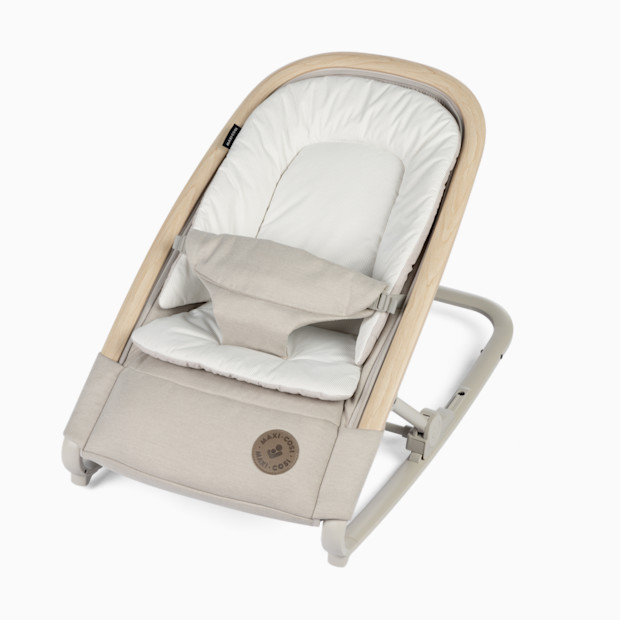
Maxi-Cosi Kori 2-in-1 Rocker - Classic Oat
From $111.99Pros
- Bounces or rocks in one seat
- Folds flat, lightweight
- Newborn insert included
Cons
- Less bouncy than dedicated bouncers
- Rocking motion struggles on carpet
- No toy bar
TL;DR
A stylish two-in-one seat that switches between a bounce and a rock motion depending on what your baby responds to, then folds flat when you're done. It's not the bounciest option and doesn't rock well on carpet, but having two motions in one seat is hard to beat.
Because some babies prefer bouncing and some prefer rocking—and you won’t know where yours lands until they arrive—some parents opt for a hybrid option. The Maxi-Cosi Kori 2-in-1 is our pick for the best baby bouncer + rocker combo. It’s what I recommend when parents ask me if they should get a bouncer or a rocker, because with the Kori, you don't have to choose.
This hybrid has three recline positions and a newborn inlay for extra support, and switching between the bounce and rock settings takes seconds. It’s sturdy, folds completely flat and is a great stand-in for your own arms when you need a break. And I’ve found that because it offers two different movement options, it tends to stick around longer. “I was able to use it for longer than I would have if it was a traditional bouncer,” a Babylist parent told us.
One Babylist parent told us: "As a single mom, it helped me to get feedings in for my son, showers in for myself, a soothing rock when he was fussy…and sometimes just a safe place to set him when I needed my hands free."
Worth noting:
If rug or carpet is your main flooring, you may be disappointed by the rocking feature—I’ve found it’s not the easiest on these types of flooring. It’s also not as bouncy as our top pick.
If you'd rather skip the bounce feature altogether, the Newton Baby Wooden Rocker is my pick for a rock-only option. In addition to being beautifully designed, it’s made from rubberwood + breathable fabrics and is GREENGUARD Gold certified.
Additional Specs
Child Guidelines: Birth to 20 lbs
Plugs or Batteries: None; uses baby's movements
Baby Swings
Best Baby Swing Overall
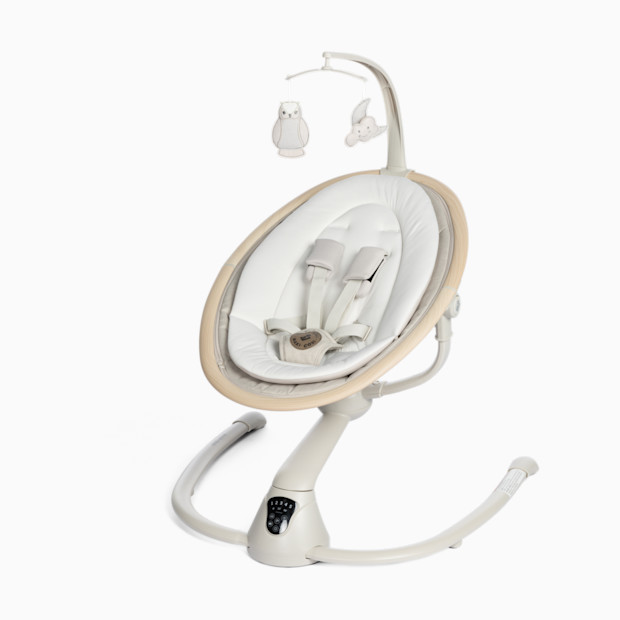
Maxi-Cosi Cassia Swing - Classic Oat
From $180.00Pros
- Reliable, durable motor
- Quiet
- Lightweight for a swing
- Automatically responds when baby fusses
Cons
- Side-to-side motion only
- Doesn’t fold
TL;DR
A quiet, reliable swing with smooth side-to-side motion and smart features that help soothe a fussy baby. It’s pricier than some options and doesn’t fold, but its lightweight design and dependable motor make it a standout.
Baby swings can be a tricky business. They’re not overly complicated, but there are a lot of similar options to choose from, so it’s easy to get overwhelmed. And many suffer the same fate: motors that give out long before the swing days are over or start making random noises along the way. (Squeaking tends to be the most common culprit.)
The Maxi-Cosi Cassia is the best baby swing overall because it gets the things that matter most right: it’s reliable, quiet, relatively lightweight and easy to use. That may not sound particularly exciting, but after testing plenty of baby swings with noisy motors, bulky frames or lots of features you may never use, I’ve learned that simple and dependable can be exactly what you want.
The Cassia has a smooth side-to-side glide with five speeds, plus 12 songs and nature sounds and two recline positions. There’s also an automatic motion sensor that detects when your baby starts fussing and kicks the swing into motion. I especially like that it’s quiet—you’re not constantly hearing the motor whirring or squeaking in the background—and it looks sleek enough that I didn’t mind having it out in my living space. “It’s the perfect swing,” said one parent.
At 10 pounds, the Cassia is also relatively lightweight for a baby swing. (Most swings are heavier than bouncers thanks to their motors and other electrical components.) It doesn’t fold, but I found it easy enough to move from room to room when needed, something I can’t say about many full-size swings.
Worth noting:
Real talk: swings are notoriously hit or miss for most babies, and you won’t really know what type of motion your baby likes, or if they like a swing at all, until they arrive. My advice is to limit the number of “baby containers” (swings, bouncers, floor seats, etc.) you register for, then add more once you have a better sense of what your baby responds to.
The Cassia is more expensive than a basic baby swing, but I think the durability and reliability help justify the price, especially if you plan to use it frequently or save it for another baby.
Some swings offer several types of movement, but the Cassia only glides side to side. If you want more motion options and customization, the Mamaroo is a better fit.
Additional Specs
Child Guidelines: Birth to 20 lbs or when baby can sit up unassisted
Plugs or Batteries: Plugs in
Best Smart Baby Swing
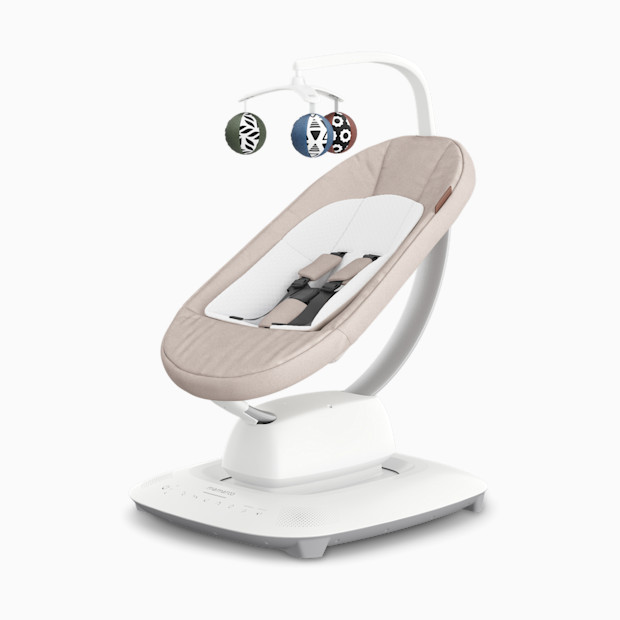
UPPAbaby Mamaroo Smart Swing - Charlie
From $349.99Pros
- 400+ customizable motion combinations
- MotionSync can mimic your own soothing movements
- App control + Alexa and Google Home compatibility
- Newborn insert included
Cons
- Expensive
- Heavy
- Some babies don't respond well to the motion
- Plugs in only; no battery option
TL;DR
The most customizable, tech-forward swing we’ve tried, with five motions, five speeds and smart features that let you personalize soothing from your phone or even mimic your own movements. It’s expensive—and not every baby loves it—but if you want maximum control over how your swing moves, nothing else compares.
If there’s one thing I’ve learned from testing baby swings, it’s that babies can be very particular about how they like to move. Some want a gentle side-to-side sway; others prefer more of a bounce. That’s what makes the Mamaroo the best smart baby swing: instead of locking you into one type of motion, it gives you more ways to experiment until you (hopefully) land on one your baby loves.
The Mamaroo has been around for over a decade, but this newest version, now made by UPPAbaby, is the most tech-forward yet. Its MultiMotion technology combines up-and-down and side-to-side movement to create five parent-inspired motions—Cruise, Bounce, Sway, Rock and Wave—each with five speed settings. There are also four built-in sounds and over 400 possible motion, speed and sound combinations. And unlike a traditional swing, you can control everything through the UPPAbaby app or use Alexa or Google Home for hands-free adjustments.
The coolest feature, though, is MotionSync. Move your phone the way you naturally rock or bounce your baby, and the app translates that movement into a personalized setting for the swing. Is it something every parent needs? Definitely not. But if your baby has a very specific preference for how they’re soothed—or you simply love smart baby gear—it’s a genuinely useful feature rather than tech for tech’s sake.
There are plenty of thoughtful non-tech details, too. The newborn insert is included, the seat has an adjustable recline, the fabrics are removable and machine washable and there’s an included mobile with removable toy balls.
Worth noting:
The Mamaroo is a big investment for a piece of gear your baby may or may not love. That unpredictability is the biggest reason it doesn’t grab the top spot on this list. One of my babies loved it, for example, while the other was definitely not a fan. Other parents agree—you can discern that after just a quick scan of reviews. (“The Mamaroo is hands down the best product we purchased,” one parent told us in our survey. “Our kid just hated it, and it’s not worth the noise or floor space,” said another.)
It’s one of the heavier swings on this list at about 15 pounds, and it needs to stay plugged in—there’s no battery-powered option.
Additional Specs
Child Guidelines: Birth to 25 lbs (approx 9 mos) or attempts to climb out
Plugs or Batteries: Plugs in
Most Versatile Baby Swing
Joie Cinnamon 2-in-1 Glider & Rocker - Frankie & Friends
From $189.99Pros
- 3 motion options: side-to-side, front-to-back or a combo
- Seat detaches to become a portable rocker
- Runs on batteries or AC power
- Infant insert included
Cons
- Heavy at over 16 pounds
- Doesn't fold for storage
TL;DR
Part swing, part portable rocker, the Cinnamon gives you more ways to soothe your baby than most swings. Choose from three motion options, then lift the seat off the base when you want a rocker you can move around the house.
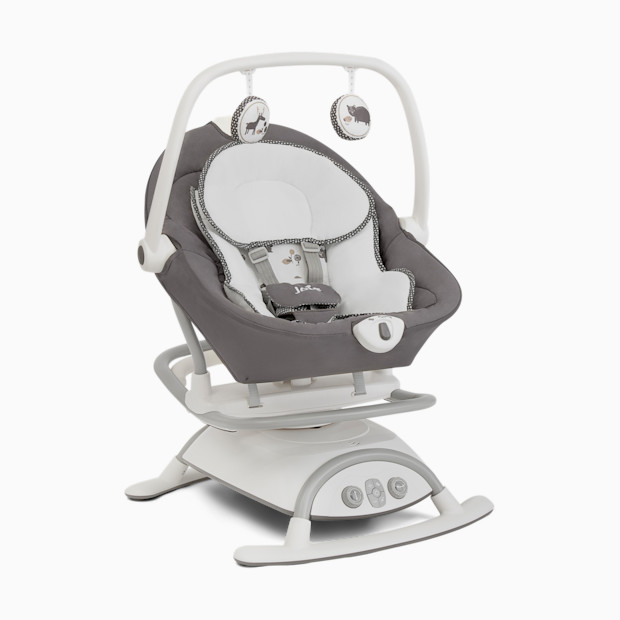
A newer addition to the market, the Joie Cinnamon is the most versatile baby swing because it offers three different types of motion and transforms into a portable rocker. That gives you more ways to figure out what your baby likes—and another option if it turns out a traditional swing isn’t their thing.
Most swings lock you into one type of motion, but the Cinnamon can glide front to back, sway side to side or combine the two movements to mimic the way you might naturally soothe your baby in your arms. You can also rotate the seat 90 degrees to change the swing’s direction, a small detail that I think can make a big difference for some babies.
The biggest selling point for me, though, is that the seat lifts completely off the base and doubles as a portable rocker. A flip-down foot stops the rocking motion when you want the seat to stay still, so you’re essentially getting a swing, rocker and stationary seat in one. And since the Cinnamon works with either batteries or an AC adapter, you have more flexibility around where you use it.
There are plenty of extras for soothing, too, including three recline positions, five songs, five nature sounds and two vibration settings, as well as an overhead toy bar. The cocoon-style seat comes with an infant insert and head support, both of which are machine washable, and the five-point harness helps keep baby securely positioned.
Worth noting:
At about 16.3 pounds, you probably won’t want to move the entire swing from room to room regularly. The detachable rocker is the more portable piece.
If floor space is a concern, the Cinnamon is designed to be more compact than Joie’s Miso 2-in-1 Swing & Rocker, but it still has a traditional swing base and doesn’t fold flat for storage.
Additional Specs
Child Guidelines: Birth to 25 lbs
Plugs or Batteries: Plug or batteries
Best Baby Swing for Small Spaces
Munchkin Bluetooth Enabled Baby Swing
From $132.99Pros
- Compact footprint
- Lightweight (~8 lbs)
- Folds for storage
- Extremely quiet
Cons
- Gentle motion may not be enough for some babies
- Side-to-side motion only
TL;DR
A compact, ultra-lightweight swing that’s easy to set up, move around and tuck away when you’re short on space. The side-to-side sway is gentler than other swings, but that may be just right for babies who don’t need a ton of motion.
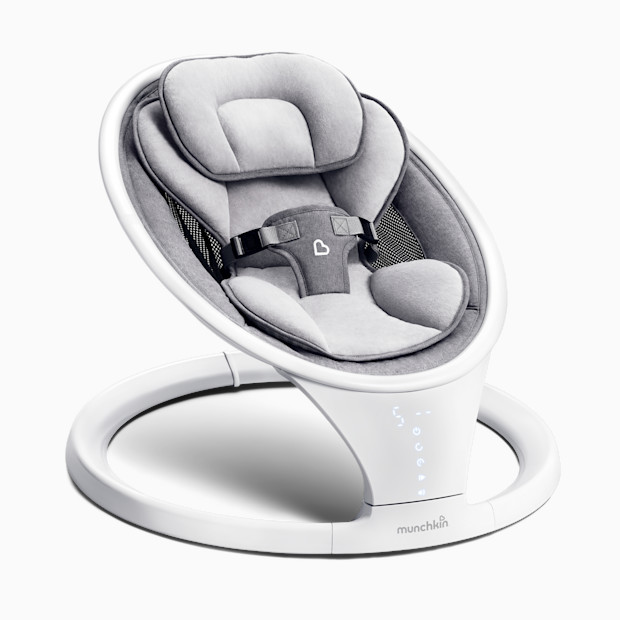
The Munchkin Bluetooth Enabled Baby Swing is the best baby swing for small spaces because it packs the soothing motion of a full-size swing into a much smaller, lighter package. At just over eight pounds and a compact footprint, it’s one of the easiest swings to fit into a small nursery, apartment or anywhere you simply don’t want baby gear taking over your living space.
I used this swing with my second baby for exactly that reason. I needed a safe spot on the second floor during the newborn days, but I didn’t want anything big or bulky taking up a ton of space. The Munchkin was perfect. It was sleek, quiet and incredibly lightweight, so I could easily move it wherever I needed it. Setup was simple, too, and it breaks down into just two pieces when you want it out of the way.
The swing itself is pretty straightforward, with a side-to-side sway and five speed settings. There’s an easy-to-use touchscreen and included remote for controlling the speed, sounds and timer, plus Bluetooth so you can stream music from your phone. (I didn’t think I’d use this feature much, but I actually did—it was fun to play songs I liked instead of the usual baby swing melodies.) The seat pad and head support are machine washable, too.
Worth noting:
This swing has a very gentle sway, and for us, it was just right. But that softer movement is also probably the biggest thing to know before buying. Some babies prefer a stronger swing or more varied motion, and for them, the Munchkin may not have enough oomph.
There’s no battery-powered option, so you’ll need to set it up near an outlet.
While it doesn’t fold in one motion, the swing breaks down into two pieces in seconds and packs fairly flat, which makes it much easier to stash away or travel with than most full-size swings.
Additional Specs
Child Guidelines: For babies 5-20 lbs who cannot sit up or climb out of swing unassisted
Plugs or Batteries: Plugs in
Best Value Baby Swing
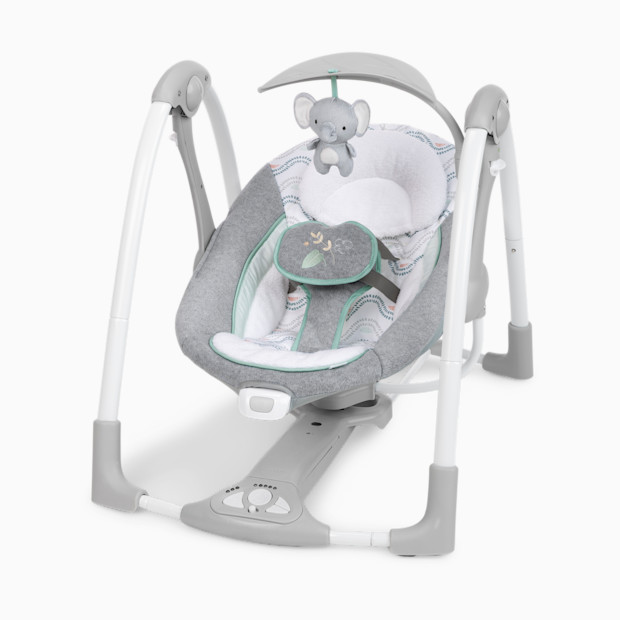
Ingenuity ConvertMe 2-in-1 Compact Portable Baby Swing 2 Infant Seat - Swell
From $89.99Pros
- Affordable
- Converts from swing to stationary seat
- Compact, fold-flat design
- 5 swing speeds + vibration
Cons
- Lower 20-pound weight limit
- Assembly required
- Vibration requires a separate battery
TL;DR
An affordable two-in-one swing and stationary seat that folds flat for storage and packs in plenty of soothing features for the price. It doesn't have the bells and whistles of pricier swings, but for under $100, there’s a lot of value here.
The Ingenuity ConvertMe 2-in-1 is the best value baby swing because for under $100, you’re getting two types of baby gear in one plus a compact, fold-flat design and many of the soothing features found on swings that cost significantly more.
The versatility is the biggest selling point for me. The ConvertMe works as an automatic swing with five speed settings, then locks into place to become a stationary infant seat. There’s also a vibration setting that works in either mode, so you have a few different ways to figure out what your baby responds to without buying multiple pieces of gear.
It’s also a good option if you don’t want a giant swing permanently parked in your living room. The whole thing folds fairly flat for storage or travel, and the toy bar pivots out of the way so it’s easier to get your baby in and out. For soothing and entertainment, you’ll get 12 melodies, four nature sounds and a plush toy. The seat pad and headrest are machine washable, and the headrest is removable as your baby grows.
Worth noting:
This is a fairly simple swing, especially compared to smart picks like the Mamaroo, but I think that’s part of the appeal. If your priority is a straightforward, compact swing with plenty of functionality at a reasonable price, you’re getting a lot for your money here.
The swing and music run via the included USB cord, but the vibration feature requires one C battery, which isn’t included.
There’s some assembly required, and the 20-pound weight limit is lower than several other swings on this list.
Additional Specs
Child Guidelines: Birth to 9 mos or 20 lbs
Plugs or Batteries: USB cord; 1 C battery required for vibration
Why Trust Babylist?
Babylist is the expert in baby; we know baby gear inside and out. We talk with parents face-to-face in our showroom and on our user panels and hear from thousands annually via our Best Baby Products online survey. We know what items millions of expecting parents are adding to their baby registries.
Firsthand professional and personal experience. Between my work role as Babylist's senior gear editor and my home role as mom of two, I've tried all kinds of gear to keep my babies calm, safe and soothed—including almost every bouncer, swing and rocker on this list.
Expert interviews. I enlisted the help of two experts while researching and writing this guide: Alexandra Cvijanovich, MD, a pediatrician in Albuquerque, New Mexico, who shared safety tips; and Marla Davis, OTD, OTR/L, a pediatric occupational therapist and owner of Bloom Pediatric Therapy and Wellness, who considered swings and bouncers from a developmental perspective.
Swing and bouncer data. We regularly analyze which baby products our users are adding to their baby registries the most (and which ones they aren’t) and what our team of Merchandising experts—our buyers who are responsible for ensuring the Babylist Shop is stocked with the best and newest gear—is excited about. Studying this kind of data helped us choose which swings and bouncers to narrow in on and which ones to recommend to new and expecting parents.
Feedback and reviews. I reviewed comments and feedback from Babylist’s annual most loved baby products survey of thousands of parents, read customer reviews from hundreds of Babylist users and spoke to parents on our staff about their real-life product experiences.
Bouncers vs. Swings: What You Need to Know
Bouncers and swings serve a similar purpose: they give your baby a safe place to hang out when you need your hands free. But they’re quite different in how they move, how much space they take up and how portable they are.
A baby bouncer is usually lightweight, compact and low to the ground. It’s powered by your baby’s own movements or a quick nudge from your hand or foot, so there are no plugs or batteries to worry about. Many also fold flat, making them easy to move around the house, store or travel with.
A baby swing is mechanically powered and provides continuous motion without any help from you or your baby. Depending on the model, it may move side to side, front to back or in several different directions, and many include extras like music, sounds and vibration. The tradeoff is size: swings tend to be heavier, bulkier and more expensive than bouncers.
Neither is a must-have, and there’s no guarantee your baby will love either one. But both can be useful for giving your arms a break or soothing a fussy baby while you stay nearby.
When can babies use bouncers and swings?
Bouncers and swings are generally designed for newborns and younger babies who aren’t yet sitting independently. Many can be used from birth until around six to nine months, but age and weight limits vary quite a bit by product. Some bouncers also convert into toddler chairs for extended use.
Always follow the manufacturer’s age, weight and developmental guidelines for your specific bouncer or swing, and stop using it once your baby reaches any listed milestone for discontinuing use, such as sitting up or attempting to climb out.
What is best, a bouncer or a swing?
Neither a bouncer nor a swing is universally better—it comes down to your baby, your space and what you want the seat to do.
Bouncers are best if you prioritize portability and a small footprint. They’re lightweight, easy to move from room to room and usually simple to store or travel with. They also don’t require electricity or batteries. The tradeoff is that the movement isn’t automatic; you or your baby will need to keep the bounce going.
Swings are best if you want consistent, hands-off motion. Once they’re turned on, they keep moving without any work from you, and many offer several speeds, sounds or motion options. They can be especially useful for babies who find repetitive movement soothing. But swings require power and are generally heavier and bulkier than bouncers.
Since babies can have strong preferences about motion, I usually recommend registering for one or the other rather than stocking up on both before your baby arrives. You can always add another option later once you know what your baby responds to.
TL;DR: If you’re tight on space or want something lightweight and easy to move around, start with a bouncer; if you want consistent, hands-off motion and have the room for it, start with a swing.
What to Look for in a Baby Bouncer or Swing
Once you’ve decided between a bouncer and a swing, here’s what I pay the most attention to:
Movement. Bouncers vary quite a bit in responsiveness, while swings may offer anything from a single gentle sway to several directions and speeds. Think about whether you want simple motion or lots of options to experiment with.
Portability and storage. Check the weight and footprint, especially if you plan to move the seat between rooms. If you’re short on space or want to travel with it, look for a model that folds flat or breaks down easily.
Seat recline and support. Multiple recline positions can make a seat more comfortable and useful through different stages. For newborns, look for adequate head and body support and check whether a separate infant insert is required.
Power source. Bouncers are generally manually powered, while swings may plug in, run on batteries or offer both. Think about where you plan to use yours and whether you’ll always have an outlet nearby.
Ease of cleaning. Spit-up and blowouts happen. A removable, machine-washable seat cover makes cleanup much easier.
Extras. Music, nature sounds, vibration, toy bars, Bluetooth and app controls can be nice to have, but don’t assume more features automatically mean a better bouncer or swing. Focus first on movement, comfort and ease of use.
How to Use Baby Bouncers and Swings Safely
Bouncers and swings can be useful places for your baby to hang out while you get something done, but they should always be used while your baby is awake and supervised.
“Bouncers or swings are best used when infants are fully awake and when there is an adult monitoring them,” says pediatrician Alexandra Cvijanovich. The American Academy of Pediatrics (AAP) also recommends limiting the amount of time babies spend in swings, bouncy chairs and car seats.
“Time should be limited to prevent them falling asleep and to allow for tummy time, which is important for development and also to prevent flattening of the baby’s head,” Cvijanovich explains.
Pediatric occupational therapist Marla Davis agrees. She says it’s okay to use a bouncer or swing when you need hands-free time, but recommends giving babies as much tummy time, floor time and unrestricted movement in a safe space as possible. Too much time in restrictive baby gear like bouncers, swings, car seats and jumpers can contribute to container baby syndrome.
Most importantly, bouncers and swings are not safe for sleep. If your baby falls asleep in one, move them to a safe sleep space as soon as possible. “When a baby is in a bouncer or swing and they fall asleep, their heads can fall forward which can compress their airway, leading to suffocation,” Cvijanovich explains.
The AAP recommends following these guidelines when using a bouncer or swing:
Move a sleeping baby. If your baby falls asleep in a bouncer or swing, move them to a firm, flat sleep surface intended for infant sleep as soon as possible.
Use the appropriate recline. Babies under four months should use the most reclined swing position to reduce the risk of their head falling forward into a chin-to-chest position.
Always use the restraints. Buckle your baby in according to the manufacturer’s instructions every time you use the seat.
Keep it stable. Always place the bouncer or swing on the floor and make sure it can’t tip over or accidentally fold.
Know when to stop. Follow the manufacturer’s weight, age and developmental limits, and discontinue use once your baby reaches any of them.
