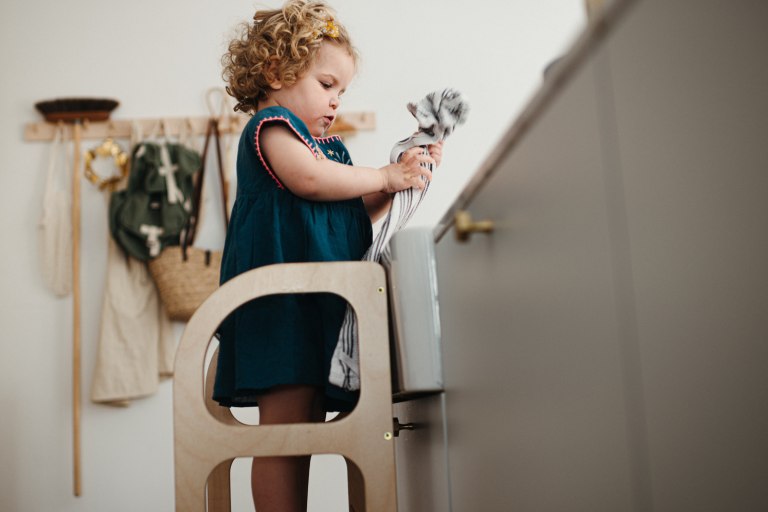
If you have a curious kitchen helper on your hands or a little one who needs to be included in all the things, a toddler tower can be a revelation. But if you've seen recent toddler tower recalls, headlines about safety incidents and injuries or the Consumer Reports' investigation into the category, you might be wondering whether these products are actually safe to use.
The short answer: yes, but with some important caveats.
Toddler towers are currently unregulated, meaning there’s no safety standard in place to govern how they’re designed, tested or sold. That’s created variation in quality across the market worth knowing about before you buy.
The good news is that once you know what separates a well-made toddler tower from a poorly made model—and how to use a toddler tower correctly—shopping for one gets a lot less complicated.
Here's what you need to know about the current safety landscape, what features actually matter and how to use a toddler tower safely once you have one at home.
What Is a Toddler Tower?
A toddler tower is a step stool optimized specifically for tiny humans. Toddler towers include kid-friendly features like safety rails, a sturdy base, multiple height positions and anti-slip surfaces. They elevate kids to counter height, making it much easier to include your littlest helper in everyday tasks like cooking, handwashing or household chores.
Depending on the brand, toddler towers go by many names: learning towers, kitchen towers, kitchen helpers, Montessori towers or toddler step stools. Some are marketed for general use, while many are aimed specifically for kitchen use to help budding chefs get involved in cooking and baking.
Are There Safety Standards for Toddler Towers?
There are currently no safety standards for toddler towers. Unlike car seats, cribs, high chairs, baby loungers and other gear, all of which are governed by federal safety requirements, there are no ASTM standards or federal guidelines that dictate how a toddler tower is designed, tested or sold. (ASTM International sets voluntary safety standards for most baby and children's products and is one of the largest standards-developing organizations in the world.)
The good news is that progress is underway. “As with many newer product categories, developing a dedicated safety standard takes time,” explains Lisa Trofe, Executive Director of the Baby Safety Alliance, the leading industry voice on quality and safety for baby and children’s products in North America.
“Manufacturers, testing labs, consumer advocates, safety organizations and government representatives are working together through the ASTM voluntary standards process to develop separate standards for children's step stools and standing towers,” she adds.
The ASTM task group met in early June 2026 to review and refine these standards. “This collaborative process helps ensure that future requirements are informed by real-world use, incident data and expert input,” Trofe explains.
Once a published standard is available, the Baby Safety Alliance will evaluate whether to incorporate the category into its Verification Program, giving parents another tool to help identify products that meet established safety requirements.
Are Toddler Towers Safe?
Toddler towers are safe, but with a big caveat: parents need to prioritize specific features when choosing one and use it correctly, and always under supervision.
“Parents shouldn't assume that the absence of a dedicated standard means toddler towers are unsafe or even untested,” explains Trofe. “What it does mean is that there is currently less consistency across the marketplace in how products are designed and evaluated. That's why proper product selection, following the manufacturer's instructions and active supervision are so important,” she adds.
What Makes a Toddler Tower Safe? Features to Look For
Since there are no safety standards in place, it’s important that parents prioritize specific features when choosing a toddler tower. Here’s what to look for, according to Trofe—and what to avoid.
✅ What to look for
Stability: a broad, sturdy base and a secure standing platform
Solid materials and durable construction
Clear usage instructions and warnings
It’s also important to choose a toddler tower that’s appropriate for your child’s age, weight, height and developmental level. Pay special attention to the toddler tower’s top rail height. A good rule of thumb is that the top guardrail should hit above your child’s belly button when they are standing in the toddler tower.
“These are all positive indicators that safety was considered during the design process,” explains Trofe.
🚩 Features to avoid
Towers that are unsteady or appear poorly constructed
Loose parts
Large gaps (usually on the sides or front) that may pose an entrapment risk if a child is able to climb through them
Missing or unclear instructions and usage guidelines
How to Use a Toddler Tower Safely
The two biggest safety concerns with toddler towers are falls and access to hazards that wouldn’t normally be in reach. That’s why the most important rule is pretty simple: never leave your child unattended in one.
“Active adult supervision is essential whenever a toddler tower is in use,” emphasizes Trofe.
A few other safety tips to keep in mind:
🔒 Always read and follow the manufacturer’s instructions, including any age, height, developmental or weight recommendations.
🔒 Place the tower on flat, stable surfaces only—never on uneven or slippery floors.
🔒 Regularly check for damage, loose parts, or wear and tear, and stop using it immediately if anything seems off.
And if you’re stashing anything that’s off limits on your counters? Remember that they’ll now have access to that space when they’re boosted up, so use extra caution. “Keep toddler towers away from hot cookware, stovetops, sharp utensils, cleaning products and other dangers that may be within a child's reach,” says Trofe.
Stay Up-to-Date with Babylist
The freshest in parenting this week, delivered to your inbox