
Baby Product Cheat Sheet: Answers to New Parents' Most Pressing Questions
Think of this as a baby product cheat sheet—because no one tells you what TOG is until you're squinting at sleep sacks at 2 a.m.

By

When it comes to baby gear, it’s normal to have a lot of questions—and sometimes the smallest details feel like the biggest mysteries. So we polled real Babylist parents in our weekly newsletter to find out their most pressing “Wait, what is that?” baby product questions. These are the questions new parents ask across the board, whether it’s in a parenting group, in product reviews or on Reddit.
From strollers to sleep sacks to those tiny ruffles on diapers, we’ve got answers. One Babylist parent even asked, "A Tonie... is this some kind of parenting award?!" So if you're feeling out of the loop, you're in good company. Below we have the most commonly asked questions grouped by category—like car seats, strollers, baby carriers, breast pumps and more.
🚙 Car Seat Questions
What's the difference between an infant car seat and a convertible car seat?
This was one of the most asked questions, so if you’re feeling confused about all of the different car seats and terminology, you’re not alone. In fact, it was one of the most asked topics in our poll: “all terms car seat wise honestly,” one Babylist parent said.
“Convertible car seat. Like what’s convertible about it? Isn’t the infant seat more convertible since it can be used on a stroller?!” another Babylist parent said in their poll response. We’re here to help clear everything up. “Infant car seats & convertible car seats...I didn't realize the convertible ones didn't come out of the base & couldn't be carried,” another parent wrote.
An infant car seat is rear-facing only and designed specifically for newborns and younger babies. It typically clicks in and out of a base that stays in your car and is often compatible with strollers for easy on-the-go use. Due to the recent side impact safety standards, most infant car seats now max out at 30 pounds.
A convertible seat is made to grow with your child. It starts rear-facing, then converts to a forward-facing seat when your child is older. Convertible car seats stay installed in your car—it’s not meant to be carried around or clicked into a stroller.
If you start with an infant car seat, you’ll switch to a convertible car seat/all-in-one car seat when your baby outgrows the height and/or weight limit.
Do infant car seats come with a base?
Many parents weren't sure if infant car seats actually come with the base, and the answer is most of the time, yes. “Every car seat on the market must be able to be installed without a base. The vast majority of them include a base, and that’s for convenience,” says Lani Harrison, a certified passenger safety technician (CPST). Be sure to check the product description to see if the seat you choose comes with a base and thoroughly read through the installation instructions.
You may see extra bases sold separately, and that’s because some people want to use their infant seat in multiple cars without having to move the base (which can be time-consuming). Some newer infant car seat models allow baseless installation with a seatbelt in a pinch—handy for travel—just be sure to triple-check this.
What does "convertible" mean in baby products?
Another term many new parents find a bit confusing is “convertible”. Babylist team member Laura shared that as a new parent, she thought that convertible car seats “were specific to people who owned convertibles, because my friend who actually has a convertible used that phrase 🤣 and I had never heard it before.”
If you see a baby product called “convertible” it usually means the product can change or adapt as your baby grows. A convertible seat (what comes next after an infant car seat) means switching from rear-facing to forward-facing. In other baby gear like cribs, strollers or high chairs, it usually means it adjusts or reconfigures for different stages. (And for the record, you can use all of these car seats in a convertible, too!)
What does "all-in-one" car seat mean?
In the same vein as infant and convertible car seats, this was another bit of terminology that left parents stumped. An all-in-one car seat combines multiple stages into one seat. It usually starts as rear-facing, then converts to forward-facing, and eventually becomes a booster seat. Some stop at the high-back booster stage, while others continue to convert into a no-back booster as well. It’s designed to last from infancy through the big-kid years—and sometimes give you up to 10 years of use.
It’s a great long-term option, but it’s not portable or stroller-compatible like an infant car seat.
How do I figure out which car seats go with what stroller?
One of the things parents spend the most time researching is stroller and car seat compatibility.
When you’re browsing these two big-ticket baby products, here’s how to find your match:
Look for car seats and strollers from the same brand, which often pair together easily
If mixing brands, check if they offer adapters—many strollers have adapters that work with popular car seats. And adapters are not universal—they’re brand- and model-specific.
Many product pages often list compatible combos to make it easier
We have a whole series to help you figure out which car seats work with what strollers: our Infant Car Seat and Stroller Compatibility Guide. You can also search for “travel systems,” which are pre-matched car seat + stroller sets.
What is an anti-rebound bar, and is it necessary?
“Rebound bar on an infant car seat base—did we need it, or not? 😅,” one parent asked in our newsletter poll. The short answer is, no. An anti-rebound bar is an added safety feature found on some infant car seats. They’re usually included with the seat, but some brands like Britax and Graco sell them separately. It’s a bar that helps prevent the secondary rebound motion that happens in the event of an impact. “If you think of a car crash, everybody in the car lurches toward the windshield or the front of the car,” explains Harrison, “Then when the car stops, everybody flops back toward the trunk. That’s the motion that the anti-rebound bar is stopping.” Think of it as a bonus layer of protection, but not a must-have for all seats (and it doesn’t mean that seats without one are any less safe).
👶🏽 Stroller & Travel System Questions
What is a travel system?
A travel system was mentioned a handful of times in parents’ poll responses—and contrary to how it sounds, it’s not just for traveling. They’re basically a car seat and stroller combo that lets you seamlessly move your baby from car to stroller without having to take them out of the car seat. It typically includes an infant car seat, a base for your car and a compatible stroller that the car seat clicks into.
It’s a popular choice for new parents because it’s convenient, often more affordable than buying items separately, and guarantees compatibility.
When your baby outgrows their infant seat, they can still use the regular stroller to stroll, but they'll need a convertible or all-in-one car seat for the car.
What’s the difference between a regular and travel stroller?
Like car seats, many parents admitted that they were overwhelmed by all of the stroller terminology as well. Especially when deciding between a “regular” stroller and a travel stroller. So, here’s what to know:
A regular stroller (aka a full-size stroller) is sturdy, often packed with features like a large storage basket, full recline and car seat compatibility. It’s great for everyday use, but can be bulky.
A travel stroller (or lightweight stroller) is also sturdy, but designed to be compact and portable—two things that make them perfect for travel, everyday errands or small spaces. Many fold down small enough to fit in overhead bins on planes!
What’s the difference between a travel stroller and a travel system?
And what about a travel stroller and travel system?
A travel stroller is all about portability—lightweight, compact, and often minimalist. A travel system is a bundled car seat and stroller combo made for seamless transitions between car and stroller. You can use a travel stroller as part of a travel system if it’s car seat-compatible (and you have the right adapter), but not all travel strollers are.
Can strollers be used from birth?
While some strollers are safe to use from birth with a bassinet attachment or a seat that lies flat and functions like one, most aren’t approved until your baby has enough head, neck and core control—which is typically around six months (though infant development is a spectrum). If you’re wondering, “So am I not supposed to stroll for the first six months??” you’re not alone. This is something quite a few new parents aren’t aware of, and a few of us on the Babylist team had this same question way back when.
This is where travel systems and stroller car seat compatibility comes into the picture. You can use a stroller with a newborn as long as you have an infant car seat and compatible adapters, or the bassinet mode or attachment mentioned above. Babies also shouldn’t be left in the car seat for long stretches of time, which is also why the bassinet can be a better option. Some brands also make something called a “stroller caddy”, which is like a stroller base you can click your infant car seat to. They’re not a full-blown stroller, though, since they don’t have a seat.
What’s the deal with front wheel locks, and when do I use them?
Front wheel locks keep the stroller’s front wheels from swiveling. Locking the front wheels gives you more stability and control, especially on bumpy paths. Leave them unlocked for smooth, everyday strolling, since swivel wheels make turning easier.
You’ll usually want to lock the wheels when:
Going over uneven terrain (gravel, grass, cobblestones)
Jogging or moving at a fast pace
Going up or down curbs (though not always necessary)
🍼 Breast Pump Questions
What does flange size mean?
One of the most confusing parts of pumping is flange size, and it was mentioned a ton in the poll.
A breast pump flange is the part of the pump that sits around the areola and nipple, and cups the breast during pumping and it’s important for two reasons: comfort and efficiency. The size correlated to the diameter of the nipple—right above and right below.
“Pumping with a properly sized flange will reduce any nipple damage and pain. You’ll also see the best output and be most likely to empty your breasts at each pumping session,” Rebekah Kimminau, International Board Certified Lactation Consultant and owner of The Baby Gear Consultant, says in our flange size guide.
US flange sizes are measured in millimeters, and most pumps come with two standard sizes—a 24-millimeter flange set and a 27-millimeter one. You may also see them labeled as small, medium and large, and these will correspond to a millimeter measurement.
Check out our Breast Pump Flange Fit Guide for tips on getting the right measurement.
What are the different breast pump types?
After car seats and strollers, pumping is the next most asked topic: “My entire breast pump!” one parent said in our poll. Another parent shared they thought a portable pump was the one that fits in your bra (which is technically true, but not the whole story—we’ll get into it below).
There are a few types of breast pumps to choose from, each with its own pros depending on how often you plan to pump and where you'll be doing it. And they can be hard to figure out at first, whether that’s deciding which one is right for you and then actually figuring out how to use the thing. One parent we polled said, “Breast pumps in general overwhelmed me, trying to figure out the pros/cons of each and which one would work best for me.” Here’s a cheat sheet:
Electric Pumps
Electric breast pumps are the standard most people think of when they picture a breast pump.
They require a power source—either a battery or a plug-in cord—to operate and contain a motor that creates the suction needed to express milk. Electric pumps have adjustable settings for suction strength and speed, so parents can find a rhythm that works for them. And within the electric pump category, there are a few different types to consider—all depending on your lifestyle and needs:
Single: Pumps one breast at a time. These tend to be more affordable and compact—ideal for occasional pumping or when you want a lightweight option.
Double: Pumps both breasts at once, saving time and often supporting better milk output. A good choice for regular use or building a milk stash.
Portable: Battery-operated and lightweight, these are designed for pumping on the go—great for work, travel or multitasking.
Wearable: Hands-free pumps that fit inside your bra. Most are wireless and tubeless, so you can move around and get things done while you pump.
Manual Pumps
Manual pumps have a lever that the user squeezes to create suction in a pattern similar to how baby would nurse, that triggers a let-down to express breast milk. This type of breast pump doesn’t require any batteries or power source, making them great for taking on the go or having as a backup in case anything goes wrong with your electric primary pump.
Are portable and wearable breast pumps the same thing?
While both portable and wearable breast pumps are designed for convenience and on-the-go use, they’re not exactly the same. “Portable—when it comes to breast pumps, I thought it meant the ones that fit in your bra,” one parent said in our poll.
Portable pumps are typically compact, lightweight and battery-operated, so you don’t need to stay near an outlet to use them. But they often still include external parts like tubing and flanges, and many need to be held in place or set on a surface while pumping.
Wearable pumps, on the other hand, are completely hands-free and fit directly inside your bra. They’re tubeless and cordless, with everything built into the pump itself—making them ultra discreet and easy to use while walking around, working or doing chores.
💡So while all wearable pumps are portable, not all portable pumps are wearable.
What do the settings on a breast pump do, and how do I use them?
Most electric breast pumps come with adjustable settings for suction strength and speed, and some even have different modes. These settings are designed to help mimic your baby’s natural nursing rhythm and make pumping more efficient.
Stimulation mode: This mode uses quick, light suction to encourage let-down (the reflex that signals your body to release milk). It usually kicks in automatically at the beginning of a pumping session.
Expression mode: Once milk starts flowing, the pump switches to slower, deeper suction to express milk more effectively. Some pumps do this automatically, while others require you to press a button.
Speed and suction settings: These let you customize the pump to your comfort and flow. A general rule of thumb: start on a lower suction and adjust as needed. It shouldn’t hurt at all—if it does, dial it back and double-check that you have the correct flange size.
It might take a little trial and error to find the right combo for your body. Don’t worry if it doesn’t feel intuitive right away—just like breastfeeding, pumping can take some getting used to.
🤱 Baby Feeding Questions
What’s let-down?
Like car seats, many parents agree that breastfeeding and pumping terminology can feel a bit intimidating. “When the lactation consultant asked about my let-down I thought she was talking about my feelings,” one Babylist parent said in their survey response. “All breastfeeding and pumping jargon was like learning a new language!”
Fun fact: when baby is breastfeeding, milk isn’t actually flowing at a constant rate the entire time—it naturally ebbs and flows, and the beginning of the flow is called a let-down.
Some parents don’t notice when they're having a let-down, while others might. If you do happen to feel it, you may also be wondering, “Why does it feel weird?” as one Babylist parent put it. Some describe it as a tingling sensation or light tightening of the milk ducts. It varies from individual to individual and if you don’t notice it, that’s also totally normal. A clue you’ve had a let-down is that baby’s sucking switches from rhythmic and quick to a longer pull and you hear a soft gulping sound.
What is cluster feeding?
One parent just wrote in the term “cluster feeding"—no doubt, because it's not immediately clear what it means. If you notice baby wanting to feed almost constantly, they’re likely going through a cluster feeding phase. This frequent pattern of feeding can happen for a few different reasons, and usually occurs in the first few days after birth. They may cluster feed for a few different reasons: they’re hungry, seeking comfort, going through a developmental or physical growth spurt or they’re compensating for a drop in breast milk supply.
Cluster feeding can also be a sign that something is off, like you’re not producing enough milk or baby doesn’t have a good latch (and isn’t getting enough during feeds). Be sure to reach out to a lactation consultant for support if you have any questions or concerns.
What is triple feeding, and why would I need to do it?
Triple feeding is another breastfeeding term that trips up some new parents. It’s a short-term feeding plan that involves three steps: nursing your baby, pumping milk and then offering that expressed milk via bottle. It’s often recommended when baby needs to gain weight, is having latch issues or if your milk supply needs boosting. It can be physically and emotionally demanding, so it’s meant to be temporary and ideally done with lactation support.
What is combo feeding?
Combo feeding (also called combination feeding) means feeding your baby with both breast milk and formula. Some families choose this from the start for flexibility or shared feeding duties, while others add formula later to supplement. There’s no one right way to do it—the best combo is the one that works for your baby and your family.
What does “anti-colic” mean?
If you’re shopping for bottles, you’ll likely come across this term. But what does anti-colic actually mean? It’s basically any product designed to help reduce colic in babies. In bottles, it means they have features like unique valves or vents that help limit the amount of air babies swallow during feeds (which can lead to a gassy tummy).
What does it mean to give a baby a "dream feed"?
Dream feeding is when you feed your baby an hour or two after they’ve gone to bed—without fully waking them up. Parents keep it as quiet and low stimulating as possible, with the goal of getting the baby full, and extending their stretch of sleep, before they themselves go to bed for the night.
What is a nipple shield?
Nipple shields are a breastfeeding tool that can help parents navigate challenges like inverted or flat nipples, feeding a premature baby or latching difficulties. They’re not a permanent solution but rather a tool to bridge the gap and make feeding more comfortable for everyone in the early days of breastfeeding. It’s best to work with a lactation consultant if you’re thinking of trying nipple shields, they’ll support you through troubleshooting nursing issues, teach you how to use nipple shields and help you wean off of using them.
When do I change bottle nipple sizes?
Bottle nipples come in different sizes, but instead of the nipple sizes varying, the sizes correlate with different flow rates. Younger babies typically need a slower flow while older babies can tolerate a faster flow rate.
A few signs it’s time to move up to the next nipple size include:
Feeds take longer than 30 minutes
Baby pops on and off the bottle or looks frustrated
Nipple is compressed or flattened during feeding
Here are a few clues baby needs a slower flow nipple:
Finishes bottles in under five minutes (the ideal range is five to 25 minutes)
Coughing, choking or milk dribbling from mouth
Red or watery eyes, furrowed brows or clicking sounds while feeding
🧸 Clothing Questions
How do I read baby clothing sizes?
As you’re preparing your home and life for baby, you’ll eventually find yourself navigating the world of baby clothing sizes. The way they’re sized is not as straightforward as one might think. “I figured a newborn was 0-3 months and ended up needing to buy a bunch of newborn-sized clothes,” one Babylist parent said in our survey.
So here’s what to know: baby clothing sizes are usually based on age and weight ranges, but sizing can vary a lot between brands. Some brands use height ranges too (in inches or centimeters), especially for sleepwear or bodysuits. Others might label items as “3M” or “6M”—which typically means up to that age, not starting at it. It's always a good idea to check each brand’s specific size chart.
💡 Pro tip: If your baby is between sizes, it’s usually safer to size up—they grow fast, and a little extra room is better than a too-snug fit.
Here is a cheat sheet to baby sizing in general, just keep in mind there can be a lot of variation between brands and even clothing type!
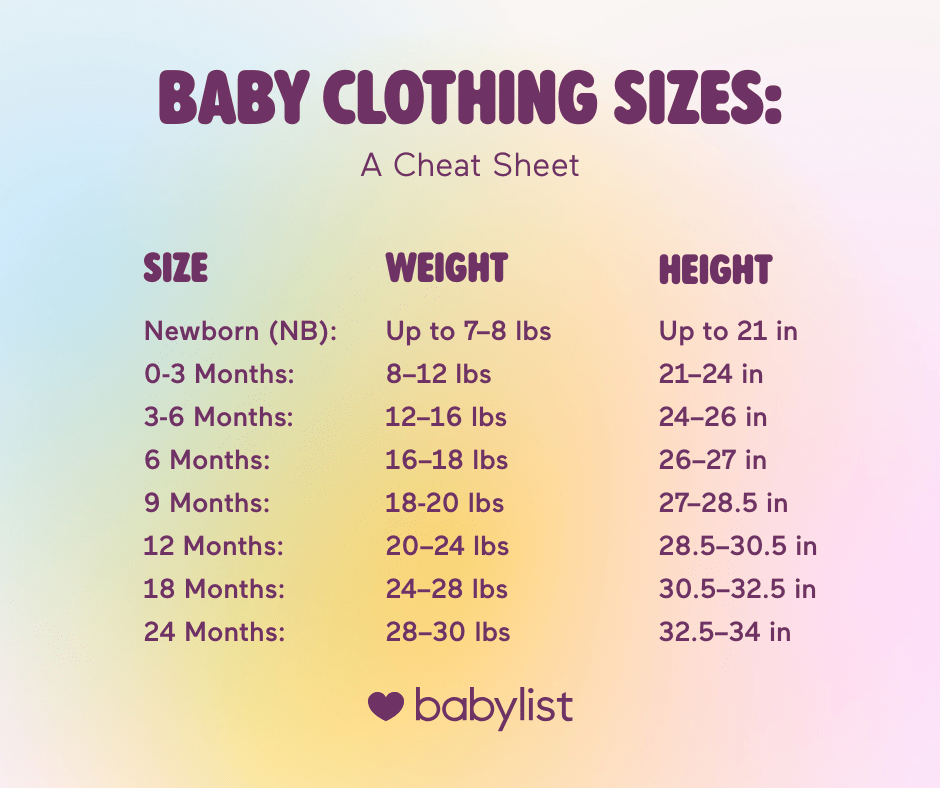
And one parent asked about the difference between 24 months and 2T (because don’t they both work for two year olds?). Technically, yes, but the 24 months size is designed to accommodate a diaper while the 2T tends to have more of a slimmer fit.
What's the difference between a bodysuit and a onesie?
There’s no functional difference—but “bodysuit” is the correct generic term. “Onesie” is actually a trademarked name owned by Gerber, so other brands can’t use it to describe their products.
A bodysuit is a one-piece baby outfit that snaps at the crotch, making diaper changes easier and helping the shirt stay tucked in. They come in short or long sleeves and are a go-to layering piece for everyday wear. Even though “onesie” is commonly used, you'll see “bodysuit” on most product listings (including ours) to keep things clear and consistent.
What is a rash guard?
One parent we polled thought a rash guard was for diapers…but it turns out, that’s a clothing term.
A rash guard is a type of swimwear top—usually with long sleeves—that offers more sun protection than a traditional swimsuit. Most are made with lightweight, quick-drying fabric and have built-in UPF, helping shield your baby’s skin from the sun’s rays during water play or beach days. By the way, they make rash guards for all ages, they’re not baby specific.
😴 Sleep Questions
What's the difference between a swaddle and a sleep sack?
A swaddle is a blanket or specially designed wrap that snugly wraps your baby’s arms and body to create a cozy, secure feeling—similar to the womb. Swaddling can help calm your baby and support better sleep in the early weeks.
A sleep sack, on the other hand, is more like a wearable blanket. Baby’s arms will be free to move, which is important for safety once they begin rolling. While they don’t offer the same snug, cocoon-like fit, they serve an extra layer of warmth and comfort once your baby outgrows their swaddle but is still too young to introduce a loose blanket.
What does TOG mean?
There are a ton of acronyms in baby products, and one in particular parents had questions about was TOG, which stands for Thermal Overall Grade. It’s basically a unit of measurement that tells you how warm a fabric will keep your baby. You’ll often see TOG ratings on sleep sacks, swaddles and wearable blankets. The higher the TOG, the warmer the fabric.
Here’s the rating range you’ll typically see:
0.5 TOG: Lightweight and breathable, great for warm rooms or summer nights
1.0 TOG: Mid-weight for moderate temperatures
2.5 TOG: Heavier for cooler rooms or colder seasons
Always check the TOG rating and match it with the temperature of your baby’s sleep environment to help prevent overheating and keep them comfortable.
What’s the difference between a bassinet, crib, cradle and playard (like the Pack ‘n Play)?
All four are safe sleep spaces for babies, but each has a slightly different design, size and purpose:
Bassinets are a small, portable sleep space designed for newborns. They usually have lower sides, making them easy to keep close by for nighttime feedings and diaper changes. Many are approved for use until baby is around three to five months old or starts rolling over.
Cribs are your standard, full-size sleep space that can be used from birth through toddlerhood (and sometimes beyond, if it converts to a toddler bed). Cribs are sturdy and stationary, and they're designed to last for years.
Cradles are similar to a bassinet in size but often designed to gently rock. Cradles aren’t as common today and tend to be more traditional or decorative. Like bassinets, they’re best for the newborn stage.
A playard (aka travel crib) is a portable, multi-use sleep and play space. Many models include a bassinet insert for newborns and can be used as a crib substitute or travel bed. They fold up easily and are great for families on the go. One of the most well-known models is the Pack ‘n Play by Graco, but many brands make their own versions.
Is it safe for babies to sleep in a Pack N’ play (aka playpen)?
All things baby sleep is a topic many new parents find themselves Googling in the middle of the night. “I’m still confused what a Pack ‘n Play is, and how/if a baby sleeps in a play space??” a Babylist parent asked. Yes—as long as it meets current safety standards and is used correctly, a Pack ‘n Play (or any playard with a firm, flat sleep surface) is a safe place for your baby to sleep.
The American Academy of Pediatrics (AAP) considers playards a safe sleep option for naps and overnight sleep, as long as:
The playard has a tight-fitting, firm mattress with a fitted sheet made for that model
There are no extra items inside (no pillows, blankets, bumpers or toys)
Your baby is placed on their back to sleep, every time
Avoid adding third-party mattresses or soft padding, which can increase the risk of suffocation. Stick with the mattress that comes with the playard unless the manufacturer offers an approved alternative.
Why does the bassinet mattress feel like a board — is it supposed to?
Yes, it’s supposed to feel that way. Bassinets are intentionally designed with firm mattresses to meet safe sleep guidelines from the AAP.
While it might feel too hard to us as adults, a firm, flat surface is safest for newborns. Soft or cushioned sleep surfaces can increase the risk of suffocation or Sudden Infant Death Syndrome (SIDS). So if the mattress feels a bit like a board—that’s actually a good sign.
It may not look super cozy, but your baby’s body is well supported, and they don’t need extra padding or plush materials to sleep comfortably and safely.
💩Diapering Questions
How do I know my baby is in the right size diaper?
Many new parents find themselves questioning all things diapers—and the most asked question parents asked in our poll was, How do I know my baby’s in the right size?
The right diaper size is mostly based on your baby’s weight, but fit and comfort matter just as much. Here are a few signs your baby is in the right size:
The diaper fits snugly but not tightly around the waist and thighs
There are no red marks on their skin after wearing it
Leaks and blowouts are minimal or rare
The tabs fasten at or near the center of the waistband without stretching too far
And here are signs it might be time to size up:
Frequent leaks or blowouts, especially around the legs or back
Red marks or chafing at the waistband or thighs
The diaper looks overly snug or doesn’t fully cover their bottom
You can’t fasten the tabs without pulling too tightly
Each diaper brand has a slightly different size chart, so if you’re unsure, check the packaging for weight guidelines—and when in doubt, sizing up usually solves most fit issues.
What do cloth diaper terms like "AIO" mean?
Cloth diapering has its own lingo, and a few parents mentioned not knowing what it all means.
Here are some common terms you’ll see:
AIO (All-in-One): Just like it sounds—everything (the absorbent inner and waterproof outer layer) is sewn together in one piece. It goes on and off like a disposable, which makes it one of the easiest cloth diaper options to use.
AI2 (All-in-Two): Similar to an AIO, but the absorbent insert snaps in or lays inside the cover instead of being sewn in. That means you can reuse the outer shell a few times before washing.
Pocket Diaper: Has a pocket between the outer layer and inner lining where you stuff absorbent inserts. You’ll need to remove the insert before washing and restuff it afterward.
Prefold: A rectangular piece of fabric that’s folded and placed inside a waterproof cover. It’s more budget-friendly but requires some folding and assembly.
Fitted: Shaped like a diaper and has snaps or Velcro, but it needs a separate waterproof cover. Offers great absorbency—especially for overnights.
Cover: The waterproof shell used over prefolds, flats or fitted cloth diapers to keep moisture in.
Each style has its pros and cons depending on your routine, how much laundry you want to do and how hands-on you want to be. Check out our Best Cloth Diapers guide for our recommendations!
Do I need to use a wipe every time I change my baby’s pee?
I remember wondering this when my first baby was born, and it turns out I am not alone because this also came up in our poll.
For wet (pee-only) diapers, the AAP says you don’t need to use a wipe every time—especially if your baby’s skin looks clean and isn’t irritated. Frequent wiping, especially with scented or alcohol-based wipes, can sometimes lead to dryness or diaper rash.
“Limiting the amount of substances, which include wipes and diapers, that your baby comes into contact with that [have] any kind of fragrances or alcohols is really important,” says Dr. Christina Johns, board certified pediatrician and Senior Medical Advisor at PM Pediatric Care. She also says that changing baby’s diaper frequently to avoid prolonged contact with a soiled diaper is also important.
That said, there are times when a quick wipe might help, like:
If your baby has sensitive skin or is prone to diaper rash
After overnight diapers, which may have more concentrated pee
If there's buildup from barrier creams or ointments
Always use a wipe after poop changes, though—that's non-negotiable for keeping things clean and avoiding irritation.
When do I use diaper cream?
In the same vein as the above, a few parents wondered if you really need to use diaper cream during each and every change?
You can use diaper cream any time your baby shows signs of redness, irritation or diaper rash—and even preventatively, if they’re prone to it. For prevention, zinc oxide-based creams work well as a moisture barrier. Just make sure your baby’s skin is clean and dry before applying. And if the rash isn’t improving after a few days—or seems severe—it’s a good idea to check in with your pediatrician.
What’s the difference between diaper creams and ointments?
The main difference comes down to texture and how they protect your baby’s skin:
Creams are usually thicker and more spreadable, with a slightly matte finish. They’re great for treating active rashes because they often contain ingredients like zinc oxide that soothe irritation and create a breathable barrier.
Ointments are more greasy or oily (think petroleum jelly–like). They’re better at sealing in moisture and protecting against wetness, making them ideal for preventing rashes or protecting already sensitive skin.
You can use both depending on your baby’s needs—some parents use ointment daily and add cream when a rash pops up.
Do I leave the packaging on wipes in the wipe warmer?
In most cases, you’ll remove the wipes from their original packaging before placing them in the warmer. Wipe warmers are designed to heat the wipes evenly, and leaving them in the plastic packaging can block the heat or cause uneven warming.
Here are a few quick tips:
Check your warmer’s instructions—some models have an inner tray or moisture pad that only works with unpackaged wipes
Don’t overfill it; adding too many wipes can cause drying or uneven warming
Always close the lid tightly to keep the wipes from drying out
Add a small amount of water (if the warmer’s manual suggests it) to maintain moisture
What are the little ruffles for around the leg openings on diapers?
This is a common question many parents have, and as a mom of two I felt it deserved a place in this guide because I personally didn’t get what they were for either. And this is a tip that’ll make you feel like a parenting pro (and save your baby’s clothing from blowout stains). Those soft, frilly-looking ruffles around the leg openings aren’t just for decoration, they’re actually called leg cuffs or leak guards.
They’re designed to:
Create a seal around your baby’s legs to help prevent leaks and blowouts
Provide flexibility so the diaper can move with your baby while still containing messes
Keep everything in place, especially during active play or when your baby starts crawling or walking
💡 Pro tip: Always make sure the ruffles are pulled out and not tucked in when you put the diaper on—this helps them do their job better.
🐨 Baby Carrier Questions
When can I start using a baby carrier?
Many new parents don’t know when they can actually start using their baby carriers. Each carrier has their own specific weight and age guidelines, so be sure to check your carrier’s instructions. Most carriers can be used starting at six to seven pounds, as long as they offer proper head and neck support and allow baby to sit in an ergonomic “M” position. Some soft structured carriers require an infant insert for smaller babies, while wraps and slings can be adjusted for a snug newborn fit.
However, there are times when you should not use a baby carrier with a newborn, including:
If your baby was born prematurely or has underlying medical conditions. Always check with your healthcare provider first.
If the carrier lacks proper head and neck support, especially for babies who haven’t yet developed strong neck muscles.
If your baby doesn’t meet the minimum weight requirement listed in the manufacturer’s guidelines.
If you’re feeling unsure or unsafe using the carrier. Babywearing should feel secure and comfortable for both you and your baby.
If you're ever in doubt, consult with your pediatrician or a babywearing educator to ensure you're using the carrier safely and effectively.
What’s the difference between a baby wrap, carrier and sling?
A few parents we polled also said figuring out the types of carriers is pretty tricky. What’s the difference between the various types? Here’s a quick breakdown:
A wrap is a long piece of stretchy or woven fabric that you wrap and tie around yourself. It offers a custom fit but has a learning curve.
A carrier (or structured carrier) has buckles or clips and usually padded straps. It’s quick to put on and offers more support for longer wear.
A sling is a single-shoulder carrier made from a loop of fabric (like a ring sling). It’s great for quick ups and smaller babies but may be less comfortable for extended use.
How long can I wear my baby in a carrier at a time?
Most experts recommend taking breaks every one to two hours, especially for newborns. Watch for baby’s cues—if they seem uncomfortable, overheated or overstimulated, it's time for a break.
Can baby carriers cause hip dysplasia?
When used correctly, most modern carriers support healthy hip development. Always keep your baby’s legs in a hip-healthy “M” position (knees higher than bottom), and avoid those that let legs dangle straight down.
🫧 Care and Grooming Questions
What’s normal for baby poop?
Newborn poop changes a lot! From tarry black meconium to mustard-yellow breastfed stools or greenish formula-fed ones—most are normal. Consistency and frequency vary, but if you see blood, white stools or mucus, be sure to reach out to your baby’s doctor right away.
How often should I give my baby a bath?
Newborns don’t need daily baths. In fact, two to three times a week is usually enough until they become more mobile. Too much bathing can dry out their delicate skin. If you do decide you want to bathe them daily, for example as part of their bedtime routine, be sure to keep their skin moisturized. In between, you can spot clean with a warm washcloth (think: neck folds, diaper area, hands and face). Once baby starts crawling or eating solids, you may bathe them more frequently.
Do I really need a baby tub thermometer?
Not necessarily, but it can give you peace of mind—especially in the early days. Baby tub thermometers help ensure the water isn’t too hot or too cold. The ideal bath temperature is around 98 to 100°F (or warm to the inside of your wrist). If you don’t have a thermometer, your own touch works just fine—just test it prior to putting baby in or running the hot water directly while baby’s in the tub.
What do I actually need in a baby medicine cabinet?
Essentials include a digital thermometer, nasal aspirator, saline spray, baby-safe pain reliever, gas drops and a soft-bristled baby brush. You might also want baby nail clippers, a humidifier and baby-safe sunscreen. Also, check out Your Pre-Baby Safety To-Do List, According to an ER Doctor for what to stock in your first-aid kit.
